




Imagine fine-tuning your eyesight the way you adjust a camera—after surgery. That’s the promise of the Light Adjustable Lens (LAL), the only FDA-approved implant your surgeon can reshape with a quick ultraviolet flash.
In one study, 79 % of LAL patients saw 20/20 without glasses, versus 33 % with a standard lens. Yet only a few Southwest Florida clinics own the tuning device and have trained teams.
ADVERTISEMENT
ADVERTISEMENT
This guide closes that gap by spotlighting the Bonita Springs surgeons who excel with the LAL and explaining the day-to-day adjustment journey—so you can pick the right partner for crystal-clear vision.
How we chose the stand-out surgeons
You deserve to see exactly why each doctor made the cut, so here is the yardstick we used.
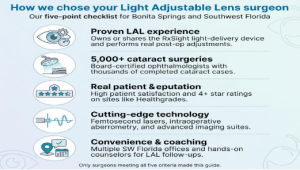
First, proven Light Adjustable Lens experience. A practice must own (or share) the RxSight light-delivery device and perform the post-op adjustments. Marketing claims without documented LAL cases did not qualify.
Second, surgical volume. We looked for board-certified ophthalmologists who have completed at least 5 000 cataract surgeries, because skill grows in the operating room, not the classroom.
Third, outcomes and reputation. Public complication data are limited, so we leaned on satisfaction signals. Healthgrades shows Dr. Brad Snead with a 4.5-star average from more than 70 reviews, a clear vote from real patients.
Fourth, tech muscle. Femtosecond lasers, intraoperative aberrometry, and seven-figure diagnostic suites let a surgeon start closer to perfect before the first light tweak.
Finally, convenience and coaching. The LAL path needs two to four quick follow-ups plus strict UV-glasses use. Groups with multiple Southwest Florida offices or hands-on counselors scored higher because they make those extra steps easy.
In short, a surgeon only rose to the top when skill, tech, outcomes, and patient care aligned for your benefit. Now that you know the rules, let’s meet the doctors who pass them with flying colors.
Snead Eye Group: family precision with a four-city reach
Walk into Snead Eye Group and the lobby buzzes, yet the team greets you by name. Founder Dr. John Snead opened the doors more than 30 years ago, and today his nephew, Dr. Brad Snead, carries the torch with meticulous manual technique plus the option of the LenSx laser for select cases.
That hands-on style pairs perfectly with the Light Adjustable Lens. Dr. Snead performs every incision himself, then fine-tunes any residual blur during follow-up light sessions. Healthgrades lists him at 4.5 stars across more than 70 reviews, a clear sign that patients leave happy and seeing sharply.
Technology backs the talent. Each office in Bonita Springs, Fort Myers, Naples and Cape Coral, Snead Eye reports, houses more than $1 million in imaging equipment that feeds directly into the RxSight adjustment unit. The data feed directly into the RxSight adjustment unit, letting Dr. Snead chase crisp 20/20 vision instead of settling for “good enough.”
Convenience seals the deal. Because the LAL journey needs two to four quick visits, four clinics spread across Southwest Florida mean less drive time for you. The Sneads call it “clearly caring.” Their patients simply call it seeing life in high definition.
Frantz EyeCare: the high-volume pioneer
Dr. Jonathan Frantz built his reputation by being first. He was the first in Southwest Florida to add a femtosecond laser to cataract surgery, the first to publish local outcomes data, and one of the first to install the RxSight light-delivery unit.
That head start matters. Extra years with the Light Adjustable Lens translate into a larger pool of real-world results. The Frantz team has already managed every scenario, from post-LASIK surprises to complex astigmatism tweaks, long before many peers saw their first case.
Scale is the second edge. With four offices and a dedicated surgery center, Frantz EyeCare performs more than 5 000 cataract procedures each year. High volume means tight protocols, seasoned scrub teams, and equipment that stays precisely calibrated.
The experience still feels personal. Counselors map your lifestyle goals before surgery, and staff preset each follow-up light session before you leave the building. Many patients finish their adjustment series within a month, vision locked at 20/20, and wonder why every appointment cannot run this smoothly.
If you prize proven processes, cutting-edge gear, and the confidence that comes from a surgeon who has logged tens of thousands of cataract cases, Frantz EyeCare deserves a spot on your shortlist.
Quigley Eye Specialists (The Eye Associates): big-network convenience, boutique-level skill
Quigley Eye Specialists recently joined forces with The Eye Associates, creating one of Florida’s largest eye-care networks. Ten clinics stretch from Bonita Springs to Port Charlotte, so a light-adjustment site is rarely more than a short drive away.
Depth of talent is another plus. Dr. Timothy Quinn, featured in Naples Illustrated as a Top Doctor, pairs thousands of cataract cases with advanced LAL expertise. Ask for him by name and you tap into a surgeon who lists the Light Adjustable Lens among his signature procedures.
Large groups can feel impersonal, yet Quigley counters that with a clear roadmap. A dedicated counselor explains UV-glasses etiquette, schedules your two or three light sessions, and stays by your side through lock-in. Patients say the process feels smooth for an organization this big.
Choose Quigley if convenience tops your list. Multiple offices let you have surgery near home, then pop into whichever branch fits your calendar for each follow-up flash. It is the logistical safety net many busy retirees and seasonal residents appreciate.
Collins Vision: boutique precision with a test-drive mindset
Collins Vision feels more like a high-end studio than a clinic. Founder Dr. Michael Collins designed it that way so every step—from corneal scans to the post-op coffee bar—reminds you this journey is personal.
That philosophy shines with the Light Adjustable Lens. Staff invite you to “test-drive” your eyesight after surgery, then sit down with Dr. Collins to sharpen any blur. An early adopter of the LAL, his team now reads adjustment data with the ease of race engineers, nudging power or astigmatism until letters snap into focus.
Technology backs the boutique feel. Intraoperative aberrometry double-checks lens power while you are still in the operating suite, and advanced topography maps each corneal ripple. By the first UV session, Dr. Collins already knows exactly what micro-tweak will take vision from good to perfect.
Patients rave about the continuity. You meet the same counselor at every visit, and Dr. Collins personally phones many patients the evening of surgery. That small-practice intimacy, paired with world-class tools, makes Collins Vision the choice for anyone who values white-glove care as much as crystal-clear sight.
Ginsberg Eye: early-adopter insight from a solo specialist
Dr. Barrett Ginsberg embraced the Light Adjustable Lens in its launch year and now counts more than 4 000 adjusted eyes. That head start shows in his results. Patients describe a tweak-and-test rhythm that feels more like custom tailoring than surgery.
Because Ginsberg Eye is a solo practice, you meet the decision-maker at every visit. Dr. Ginsberg performs your measurements, your surgery, and each light session. If you want to sharpen distance vision by a hair or trade a touch of clarity for near work, he helps you weigh the options on the spot.
The North Naples office looks compact, but the tech inside is anything but. The RxSight light-delivery unit sits steps from the exam chairs, so two-minute adjustments fit easily into a busy week. Most patients finish lock-in within four weeks and leave raving about crisp dashboard gauges and effortless menu reading.
Choose Ginsberg Eye if you value unbroken continuity and the confidence that comes from a surgeon who has been fine-tuning LAL outcomes longer than almost anyone else in Southwest Florida.
Quick-compare snapshot
Choosing a surgeon often comes down to the finer points: drive time for light treatments, total LAL case count, or real-world patient praise. The table below puts those details side by side.
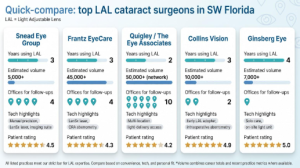
*Volume combines surgeon career totals and recent practice metrics where available.
Every surgeon here meets our strict bar for LAL expertise. Scan the grid, match convenience, tech, and reputation with your priorities, then book the consultations that feel right.
Light Adjustable Lens vs. standard vs. multifocal: what really changes for you?
Picking a premium lens can feel like choosing a phone plan—similar jargon, big price swings, and plenty of fine print. Let’s clear the fog.
The Light Adjustable Lens is unique because it can be fine-tuned after surgery. A quick ultraviolet treatment reshapes the implant so your final prescription lands on the bull’s-eye. In a clinical trial, seventy-nine percent of LAL eyes reached 20/20 vision without glasses, compared with thirty-three percent for a standard monofocal lens.
Standard monofocal lenses are the workhorses Medicare covers. They deliver crisp distance vision, yet you will still grab readers for menus and phone screens. What you see on day one is what you live with—no do-overs.
Multifocal and trifocal lenses chase a different goal: simultaneous distance and near focus. Many patients enjoy a glasses-free lifestyle, but the concentric rings can scatter light, and halos around headlights are the most common trade-off.
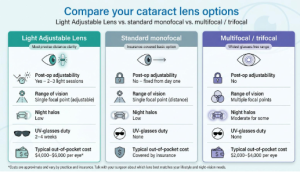
| Feature | Light Adjustable Lens | Standard monofocal | Multifocal / trifocal |
| Post-op adjustability | Yes, two to three light sessions | No | No |
| Range of vision | One focal point (adjustable) | One focal point | Multiple focal points |
| Night halos | Low (monofocal optics) | Low | Moderate for some |
| UV-glasses duty | Two to four weeks until lock-in | None | None |
| Typical out-of-pocket cost | $4 000–$6 000 per eye | Covered by insurance | $2 000–$4 000 per eye |
If nailing perfect distance clarity is your priority—and you do not mind a few weeks in protective glasses—the LAL is a strong choice. Prefer fewer follow-ups and do not mind readers? The standard lens keeps life simple. Want the broadest visual range and can tolerate a glow around streetlights? A modern multifocal may fit.
Your surgeon will walk you through these nuances. Now you can meet that conversation on equal footing.
What to expect: from surgery day to lock-in
Cataract surgery with the Light Adjustable Lens starts like any routine case, but the weeks that follow feel refreshingly interactive.
Surgery day
You arrive at the ambulatory center, receive numbing drops and a light sedative, and rest in a recliner. The cloudy lens is removed, the photosensitive implant goes in, and you head home wearing wrap-around UV glasses.
Why the glasses matter
The lens remains adjustable until its final light treatment, so you must block stray ultraviolet rays during waking hours. Keep the glasses on from surgery until 24 hours after the last lock-in flash. The rule is non-negotiable, but most patients adapt within a day.
First follow-up (about 14 days)
After the eye calms, your doctor measures vision and programs the first adjustment. You sit at the light-delivery device; a soft blue glow bathes the lens for 90 seconds. The treatment is painless, and many people notice sharper vision that evening.
Additional adjustments (every 3–5 days as needed)
Most eyes need two sessions; a few require a third. Each visit includes a quick check, a short light exposure, and a return to normal activity—still wearing the UV glasses.
Lock-in (final visit)
When you and your surgeon agree the view is perfect, one last light pulse cures the lens permanently. Glasses come off the next day, and you rejoin pickleball, boating, or night driving with confidence.
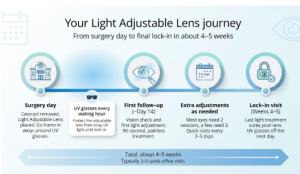
From first incision to final lock-in, the process spans four to five weeks and involves only three to five quick office visits. It is a small commitment for dialed-in clarity that can last a lifetime.
FAQs
Will I still need glasses after a light adjustable lens?
Most people enjoy crisp distance vision without spectacles. In one clinical trial, seventy-nine percent of LAL eyes reached 20/20 unaided, versus 33 % with a standard monofocal lens. You may still keep light readers for fine print, but everyday tasks usually stay glasses-free.
How long do I have to wear the UV-blocking glasses?
Plan on two to four weeks. Wear the wrap-around shades during all waking hours until 24 hours after the final lock-in treatment to protect the lens while it is still adjustable.
Is the upgrade covered by Medicare?
Medicare and most commercial plans pay for basic cataract surgery and a standard lens. The Light Adjustable Lens and its light sessions are elective upgrades that practices quote at $4 000 to $6 000 per eye. Many offices offer financing or HSA guidance.
Who is the best surgeon for the LAL in Bonita Springs?
“Best” depends on what you value. If patient-satisfaction scores sway you, Dr. Brad Snead’s 4.5-star average across more than 70 Healthgrades reviews makes him a strong choice. Others excel in volume, technology, or boutique service. Use our quick-compare table to match a surgeon’s strengths with your goals.
Can the lens be tweaked years later?
No. The adjustability window closes after the final lock-in flash. If your prescription drifts in the future—a rare event—you would address it with glasses, LASIK, or, in uncommon cases, a lens exchange.
What if I had LASIK years ago?
Previous corneal surgery can complicate lens power calculations. The LAL often offers the safest bet because your surgeon can fine-tune any residual surprise after healing rather than guessing up front.
Do light treatments hurt?
Patients describe them as uneventful. You stare at a blue target for about 90 seconds per eye, feel no heat or pressure, and head home wearing the same UV glasses you arrived in.
Takeaways
Armed with an understanding of the Light Adjustable Lens, the local surgeons who excel with it, and what to expect during recovery, you are ready to book consultations with confidence. Match each doctor’s strengths—whether high-volume efficiency, boutique service, or unbroken continuity—with your personal priorities, and take the next step toward crystal-clear vision for years to come.
Editorial Disclosure: This article contains promotional content and provider recommendations. DiseaseFix does not independently verify all claims regarding individual surgeons, clinics, patient outcomes, or treatment results. Readers should consult a qualified ophthalmologist before making healthcare decisions.
Related Reads



Latest Posts




ADVERTISEMENT