


Role of Cathepsin B (Ctsb) Recombinant Protein in Alzheimer’s Disease Research
- Updated on: Jul 29, 2026
- 3 min Read

Mohd Sadiq is a bioinformaticist with a special interest in Nanotechnology. He completed his Master’s degree from Jamia Millia Islamia University, New Delhi, followed by an internship in the Department of Plant Molecular Biology, University of Delhi, South Campus. Mohd Sadiq has also worked at Codon Biotech Pvt. Ltd. Noida.
By
- Published on Jul 29, 2026
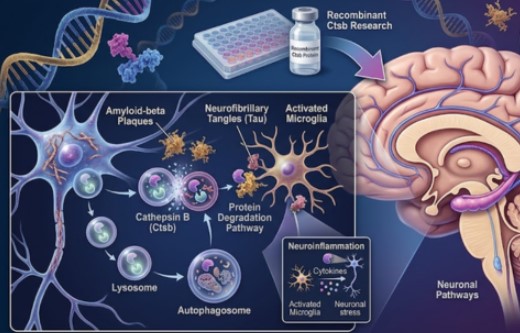
Alzheimer’s disease is a progressive neurodegenerative disorder that gradually destroys brain cells. This leads to a decline in memory, thinking, learning and reasoning abilities. It is the primary cause of dementia, accounting for approx 60% to 70% of all dementia cases worldwide. Today, more than 57 million people are living with dementia.
While the exact cause of Alzheimer’s disease is unknown, researchers believe it is a result of a combination of genetic, environmental and lifestyle factors that damage brain cells over time.
ADVERTISEMENT
ADVERTISEMENT
During Alzheimer’s disease, formation of amyloid-beta plaques outside nerve cells and neurofibrillary tangles made of abnormal tau proteins inside neurons can be seen. These changes disrupt communication between brain cells and trigger inflammation. As a result, neurons start to die.
In addition, chronic neuroinflammation, oxidative stress, mitochondrial dysfunction, impaired autophagy, and lysosomal dysfunction contribute to disease development.
The symptoms of Alzheimer’s disease develop gradually and worsen over time. Common symptoms include:
- Progressive memory loss
- Difficulty solving problems
- Confusion about time
- Confusion about places
- Language and speech difficulties
- Poor judgment
- Misplacing everyday items
- Mood and personality changes
- Difficulty recognizing people
- Loss of daily independence
Over time, Alzheimer’s disease can prevent individuals from recognizing loved ones, performing basic daily activities, or caring for themselves. In the advanced stages, complications such as pneumonia, malnutrition, dehydration, and infections become common and are among the leading causes of death in people with Alzheimer’s disease. That is why early diagnoses and treatment are crucial. Here is where Cathepsin B (Ctsb) recombinant protein comes into play.
What is Cathepsin B (Ctsb) Recombinant Protein?
Cathepsin B (Ctsb) is a lysosomal cysteine protease that helps break down proteins inside cells. Under normal physiological conditions, it helps maintain cellular health by participating in protein degradation, autophagy, antigen processing, tissue remodeling, and apoptosis. Since neurons rely heavily on efficient protein clearance, Cathepsin B is critical for normal brain functioning.
Cathepsin B (Ctsb) recombinant protein is a laboratory-produced version of the naturally occurring enzyme. It is generated using recombinant DNA technology. It is manufactured in controlled expression systems, such as bacterial, yeast, insect, or mammalian cells. It produces highly purified and biologically active protein for research applications.
These proteins are known for:
- High purity
- Batch-to-batch consistency
- Reliable enzymatic activity
- Minimal contamination
In Alzheimer’s disease research, recombinant Cathepsin B helps study amyloid-beta metabolism, lysosomal function, autophagy, neuroinflammation, and neuronal protein degradation. This further helps scientists understand how Cathepsin B contributes to disease progression. In addition, it helps decide whether targeting this enzyme could lead to new therapeutic strategies for Alzheimer’s disease.
How Cathepsin B Recombinant Protein Help in Alzheimer’s Disease Research?
-
Study Amyloid-Beta Processing
During Alzheimer’s disease, accumulation of amyloid-beta plaques in the brain can be seen. These plaques form when amyloid precursor protein (APP) is improperly processed. As a result, amyloid-beta peptides accumulate in the brain.
At times, researchers use Cathepsin B to investigate its involvement in amyloid-beta metabolism. Cathepsin B may help degrade amyloid-beta peptides and thereby helps support the clearance of toxic protein aggregates. In addition, Cathepsin B may influence APP processing under certain conditions.
Researchers use recombinant Cathepsin B protein to study these enzymatic activities in controlled laboratory environments. This helps scientists understand how the enzyme affects amyloid-beta formation and clearance pathways.
-
Understand Lysosomal Dysfunction
Lysosomes are cellular structures responsible for breaking down damaged proteins and waste materials. Proper lysosomal function helps maintain healthy neurons.
In Alzheimer’s disease, impaired lysosomal activity can result in the accumulation of abnormal proteins, which further leads to neuronal damage. Since Cathepsin B is a key lysosomal enzyme, recombinant protein allows researchers to investigate:
- Lysosomal enzyme activity
- Protein degradation pathways
- Cellular waste removal mechanisms
- Autophagy regulation
These studies help researchers understand how disruptions in cellular clearance systems contribute to Alzheimer’s disease progression.
-
Investigate Neuroinflammation
Neuroinflammation plays a significant role in Alzheimer’s disease development. Activation of immune cells in the brain, such as microglia, can release inflammatory molecules that damage neurons.
Cathepsin B has been linked with inflammatory signaling pathways, including pathways involved in inflammasome activation. Researchers use recombinant Cathepsin B to analyze its role in:
- Inflammatory responses
- Cytokine production
- Microglial activation
- Immune signaling pathways
This helps researchers identify new ways to control inflammation-related neuronal damage.
The Bottom Line
Now that you know how recombinant Ctsb proteins help in Alzheimer’s disease research, what are you waiting for? Find a trustworthy supplier to buy high-quality proteins and start your research now!
Share this article


Latest Posts





ADVERTISEMENT