



BPC-157 Peptide: A Comprehensive Overview of Its Role in Tissue Regeneration and Gut Health
- Updated on: Sep 16, 2026
- 3 min Read

Arshi Anjum is a qualified homeopath who believes alternative medicine disciplines can really do wonders in certain situations and particularly for some conditions and diseases. She completed her medical education from Bakson Homeopathic Medical College, Greater Noida, India.
- Published on Sep 16, 2026
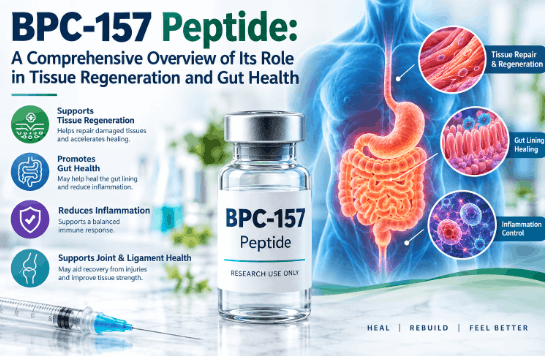
Recent advances in translational tissue repair have drawn focused clinical interest toward synthetic signaling molecules capable of accelerating biological recovery. Among these compounds, BPC-157—a synthetic pentadecapeptide modeled after a naturally occurring sequence in human gastric juice—has shown pronounced cytoprotective and repair-stimulating actions in preclinical literature. Research indicates that the compound operates across diverse physiological systems, influencing both musculoskeletal matrix repair and gastrointestinal lining stability. This paper evaluates the documented biochemical mechanisms, preclinical observations, and therapeutic considerations surrounding BPC-157.
What Is BPC-157?
BPC-157 (Body Protection Compound-157) is a 15-amino-acid synthetic peptide representing a partial sequence of a protective protein naturally synthesized in the human stomach. In its native biological environment, the precursor protein helps preserve mucosal barrier integrity against digestive acids and enzymatic stress.
ADVERTISEMENT
ADVERTISEMENT
Unlike biologically active compounds with highly localized effects, preclinical models suggest BPC-157 exerts systemic activity. In vivo rodent trials demonstrate accelerated healing across various tissue classes, including transected tendons, torn ligaments, crushed skeletal muscle, and damaged bone tissue. Furthermore, the peptide exhibits protective characteristics against toxic, ischemic, and inflammatory injuries in visceral organs. While human clinical data remains scarce, the reproducibility of these findings across diverse laboratory protocols makes BPC-157 an active subject of translational research.
Proposed Biochemical Mechanisms
The therapeutic action of BPC-157 is driven by several distinct signaling pathways that collectively support tissue homeostasis and structural repair:
Nitric Oxide Pathway Modulation
BPC-157 interacts directly with the nitric oxide (NO) system, a central regulator of vascular tone and tissue perfusion. By stabilizing NO production, the peptide promotes controlled angiogenesis—the formation of new blood vessels from existing vasculature. This enhanced capillary network accelerates the delivery of oxygen and cellular nutrients to damaged, hypoxic tissue beds.
Upregulation of Pro-Healing Growth Factors
Laboratory studies show that BPC-157 increases the expression and signaling efficiency of specific growth factors, including Vascular Endothelial Growth Factor (VEGF) and Transforming Growth Factor-beta (TGF-β). These proteins control cellular migration, fibroblast proliferation, and collagen synthesis, which form the structural framework of regenerating tissue.
Cytoprotection and Cytokine Control
Uncontrolled inflammation delays structural repair and contributes to chronic tissue degeneration. BPC-157 modulates key inflammatory mediators, attenuating excessive pro-inflammatory cytokine expression while maintaining the targeted immune response necessary for cellular clearance and rebuilding. Its gastric origin also confers direct cellular defense mechanisms against oxidative stress.
Central Nervous System Interactions
Preliminary animal research demonstrates that BPC-157 modulates central dopaminergic and serotonergic pathways. Rodent models of traumatic brain injury and toxic neuro-insults show improved functional outcomes and reduced neuronal damage, suggesting potential applications in neuroprotection and nerve repair.
Primary Therapeutic Target Areas
Although BPC-157 remains an investigational compound without formal approval from regulatory bodies such as the FDA or EMA, extensive animal data highlights several key focus areas:
Musculoskeletal and Connective Tissue Repair
Tendons and ligaments exhibit limited intrinsic healing capacity due to low baseline vascularity. In animal models featuring Achilles tendon transections and medial collateral ligament tears, BPC-157 administration consistently yields faster functional recovery, enhanced collagen fiber alignment, and higher mechanical tensile strength compared to control groups.
Gastrointestinal and Epithelial Integrity
Reflecting its origins in gastric secretions, BPC-157 demonstrates strong mucosal repair capabilities. Experimental models of inflammatory bowel disease (IBD), gastric ulcers, and NSAID-induced enteropathy show reduced mucosal damage and improved tight-junction integrity following treatment. These observations suggest potential therapeutic relevance for chronic inflammatory conditions of the digestive tract.
Microvascular and Wound Healing
Enhanced microvascular formation directly accelerates skin wound closure, surgical incision recovery, and burn healing. By stimulating endothelial cell migration and organizing extracellular matrix deposition, BPC-157 aids tissue reconstruction in compromised wound beds.
Current Research Status
The existing body of evidence for BPC-157 is largely built on in vitro cell cultures and animal models published in peer-reviewed scientific journals. While these findings demonstrate clear mechanisms of action, double-blind, placebo-controlled human clinical trials are necessary to confirm clinical efficacy, establish biological half-life in human tissue, and determine accurate therapeutic dosing schedules.
The compound is also receiving attention in field studies exploring longevity and anti-aging therapeutics, where researchers investigate whether systemic inflammation reduction and continuous tissue maintenance can slow age-related structural decline.
As regulatory classifications vary by jurisdiction, BPC-157 is currently made available primarily for scientific research and laboratory evaluation. Clinicians and researchers must evaluate ongoing safety trials and official regulatory updates.
Safety and Pharmacological Profile
Animal toxicology evaluations report high tolerability for BPC-157, with no lethal dose ($LD_{50}$) established in rodent models and an absence of significant organ toxicity at working concentrations. The peptide maintains biological activity across oral, subcutaneous, and intraperitoneal routes of administration in laboratory settings.
However, because comprehensive human Phase I–III clinical trial data is not yet available, potential human toxicity profiles, drug interactions, and long-term side effects cannot be fully ruled out. Use outside controlled clinical trials requires careful consideration of these data gaps.
Conclusion
Preclinical research positions BPC-157 as a uniquely versatile candidate in regenerative medicine. By stimulating angiogenesis, modulating inflammatory signaling, and supporting cellular matrix reconstruction, it addresses fundamental challenges in connective tissue and mucosal repair. As clinical research continues to evaluate BPC 157 and related regenerative compounds, structured human trials will ultimately determine how these laboratory findings translate into safe and standardized therapeutic applications.
Disclaimer: This article is intended strictly for educational and informational purposes and does not constitute medical advice. BPC-157 is an investigational peptide not approved by the FDA for human therapeutic use. Medical decisions should always be made in consultation with a qualified healthcare professional.
Share this article



Latest Posts




ADVERTISEMENT