


Why Identity Testing Matters More Than Purity for Research Peptides Like Retatrutide
- Updated on: Oct 12, 2026
- 4 min Read

Shahid is a pharmacologist with masters in pharmaceutical sciences and pharmacology. In the past, he worked for Maxinov Healthcare Research Division and R.P Biotech. At DiseaseFix, he is a content guide and writer. He is also associated as a researcher with Integrated Resources Pvt Ltd. currently. Shahid’s areas of interests include cellular and molecular pharmacology, pre-clinical screening, and systemic and clinical Pharmacology.
- Published on Oct 12, 2026
What this guide covers
Purity is the first number anyone looks at. It sits at the top of the listing, usually with a decimal point, and it feels like the whole story. It is half of it. A purity figure tells you how clean a sample is. It does not tell you what the sample is. I spend a good part of my week reading certificates, and the gap between those two questions is where most of the trouble I see starts. This guide explains the difference in plain terms, shows how two common lab instruments answer two separate questions, and gives you a way to read testing claims with a bit more skepticism. No chemistry degree required.
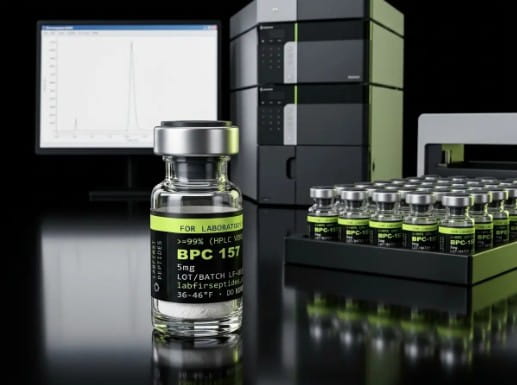
HPLC purity trace for a BPC-157 research lot, LabFirst Peptides
ADVERTISEMENT
ADVERTISEMENT
What is the difference between identity and purity?
Think of a bag of coffee beans.
Purity asks: how much of this bag is coffee beans, and how much is dust, stems and broken bits? A bag that is 99% beans is very clean.
Identity asks something else. Are these beans the variety printed on the bag? You could have a bag that is 99% pure beans of the wrong kind. Clean, consistent, and still not what you paid for.
Research peptides work the same way. A sample can be very pure and still be the wrong molecule, a shortened version of the right one, or a close cousin with one building block swapped out. Purity alone cannot catch that. Identity testing can.
Why can a high purity number still mislead you?
Because purity is measured relative to whatever is in the vial. The test looks at the main substance and asks what share of the total it makes up. If the main substance is the wrong compound, the math still works. You still get a tidy percentage.
There is a second issue. Peptides are chains of amino acids, and small errors during manufacturing can produce chains that are almost right. One missing link. One link in the wrong order. These near misses can behave very similarly in some tests, which means a purity method may not separate them cleanly from the real thing.
So when a listing shows a big purity number and nothing else, it has answered the easier of the two questions.
How does HPLC work, in plain English?
HPLC stands for high performance liquid chromatography. The short version goes like this.
The sample is dissolved and pushed through a narrow tube packed with material that different molecules stick to more or less strongly. Molecules that stick less come out first. Molecules that stick more come out later. A detector at the end records each one as it exits, and the result is a graph with peaks.
A clean sample shows one tall peak and very little else. The size of that main peak, compared with all the peaks together, gives the purity percentage.
What HPLC does well: it shows how much other material is mixed in.
What it cannot do on its own: prove what the main peak is. It tells you something came out at a certain time. It does not read the molecule’s label.
How does mass spectrometry confirm a peptide like Retatrutide?
Mass spectrometry weighs molecules. Very precisely.
Every peptide has an expected mass based on its exact sequence of amino acids. The instrument turns molecules into charged particles, sends them through a field, and measures how they move, which reveals their mass. If the measured mass matches the expected one, that is strong evidence the molecule is what the label claims.
If a chain is missing an amino acid, its mass drops by a known amount. If something has been swapped, the mass shifts. Mass spectrometry catches those differences where a purity test might not.
The two methods belong together. HPLC says “this is clean.” Mass spectrometry says “and this is the right thing.” You want both answers on paper. I have had certificates cross my desk with a beautiful chromatogram and no mass result at all, and the seller was surprised anyone asked.
For a deeper walk through these methods, LabFirst has a plain guide to peptide purity testing that covers what each test can and cannot show.
Do this in order
- Find the certificate of analysis for the exact product and lot you are looking at, not a generic sample.
- Look for two separate results: one for identity and one for purity.
- Check that the identity result names a method, usually mass spectrometry, and reports a measured mass.
- Compare the measured mass with the expected mass for that compound. They should be very close.
- Look at the purity result and confirm it names a method, usually HPLC, with a chromatogram if possible.
- Confirm the lot number on the certificate matches the lot number on the product.
- Check the test date. Old results on a new batch tell you nothing about that batch.
If you want to practice on a real example, the retatrutide certificate of analysis guide walks through one document line by line.
What are the red flags?
- A purity percentage with no identity result anywhere
- An identity result that says “conforms” with no measured mass or method named
- One certificate reused across many lots or many products
- A chromatogram image that looks cropped, blurry or identical between products
- No lot number, or a lot number that does not match the product
- Testing claims in the product description that never appear on an actual document
The short version
Purity is a cleanliness score. Identity is a name check. A research material can ace the first and flunk the second, and only identity testing will tell you. When you compare suppliers, look for both results on a lot-specific certificate before you trust any percentage. A listing like this retatrutide peptide page shows where that documentation should sit: right next to the product, tied to a lot.
Common questions
Is 99% purity always better than 98%?
Only if both samples have confirmed identity. A higher number on the wrong molecule is still the wrong molecule.
Can one test do both jobs?
Some combined setups exist, but a certificate should still report identity and purity as separate results.
Why don’t all suppliers show mass spec data?
It costs more to run. That cost is part of why documented material can be priced higher.
Research compounds discussed here are sold for laboratory research use only and are not intended for human or animal use. This guide is not medical advice.
Share this article







ADVERTISEMENT