


What Is HPLC? How Labs Use HPLC and Mass Spectrometry to Read a Peptide’s Certificate of Analysis
- Updated on: Oct 22, 2026
- 3 min Read

Shahid is a pharmacologist with masters in pharmaceutical sciences and pharmacology. In the past, he worked for Maxinov Healthcare Research Division and R.P Biotech. At DiseaseFix, he is a content guide and writer. He is also associated as a researcher with Integrated Resources Pvt Ltd. currently. Shahid’s areas of interests include cellular and molecular pharmacology, pre-clinical screening, and systemic and clinical Pharmacology.
- Published on Oct 22, 2026
What is HPLC, and why does it appear on almost every certificate of analysis for a research peptide? HPLC stands for high-performance liquid chromatography, a technique that separates a sample into its components so a lab can see how much of it is the intended compound. Paired with mass spectrometry, it forms the backbone of peptide quality testing. A useful worked example is the third-party tested retatrutide listed by Alpha Carbon Labs, where each batch carries an HPLC purity result and a batch-specific certificate from an outside laboratory.
The diluent used to return a freeze-dried peptide to solution has its own test data, too. Direct Bac Water, for instance, publishes an independent lab report covering a sample of its bac water 10ml vials, measuring the preservative level and pH. Reading both kinds of report is a core lab skill.
ADVERTISEMENT
ADVERTISEMENT
What Is HPLC?
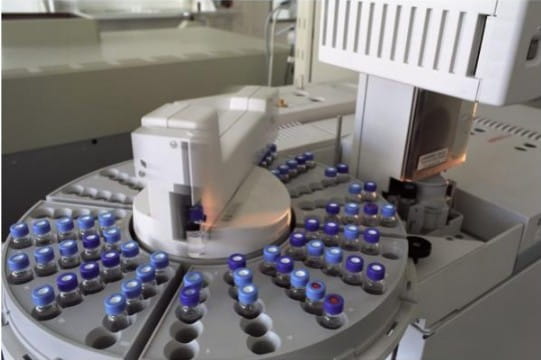
In high-performance liquid chromatography, a dissolved sample is pushed under high pressure through a narrow column packed with fine particles. Different molecules interact with the column material to different degrees, so they travel through it at different speeds and emerge, or “elute,” at different times. A detector at the end, often measuring ultraviolet absorbance, records each component as a peak on a graph called a chromatogram.
For a peptide, the main peak represents the target molecule. Smaller peaks represent impurities, such as truncated sequences or by-products of synthesis. Purity is usually reported as the area of the main peak as a percentage of the total peak area.
What HPLC Can and Cannot Tell You
HPLC is excellent at answering one question: how much of this sample is a single, dominant component? It is less good at answering a second: is that component the right molecule? Two different peptides can elute at similar times, and an HPLC trace on its own does not identify a compound by structure. A purity percentage also depends on the method used, including the column, the detector and the run conditions, which is why a certificate should state the method rather than only the number.
Where Mass Spectrometry Comes In
Mass spectrometry (MS) measures the mass of a molecule by ionising it and recording its mass-to-charge ratio. Because each peptide has a predictable molecular weight based on its sequence, MS is a strong check on identity. If the measured mass matches the expected one, the lab has good evidence that the main HPLC peak is the intended compound. Many labs combine the two techniques in a single instrument, known as LC-MS.
This is why the most informative certificates report both. Alpha Carbon Labs describes its products as “HPLC & Mass Spec 2X Tested,” and lists the molecular formula, molecular weight and CAS number for retatrutide on the product page, giving researchers reference values to compare against the certificate.
How to Read a Peptide COA, Step by Step
Find the batch number. Check that it matches the number on your vial.
Check the compound and identifiers. Name, sequence or CAS number should match the product.
Look for the HPLC result and method. Note the purity figure and the conditions used.
Look for the MS result. The measured mass should agree with the expected molecular weight.
Confirm the tester and date. A named, independent laboratory and a recent date add credibility.
Researchers should also notice when two figures on a page do not match exactly, for example a general specification and a batch result. The batch certificate is the document that applies to the vial in hand.
A Quick Word on Retatrutide
Retatrutide is an investigational peptide designed to engage three receptors, GLP-1, GIP and glucagon. It is not approved by the FDA or any other regulator. Eli Lilly, which developed it, says it is available only to participants in its clinical trials. Material sold for research is for laboratory use only, and Alpha Carbon Labs states on its page that its product is not for human or veterinary use.
The Diluent Has a Certificate Too
Lyophilised peptides are usually returned to solution with bacteriostatic water, sterile water preserved with benzyl alcohol. Here, the relevant tests are different. Rather than purity by HPLC, a lab wants to know the preservative concentration and the pH. Direct Bac Water’s product page reports that the independent laboratory Chromate analysed a 10 mL sample from lot 260121 (report #38663), measuring benzyl alcohol at 0.912% against a 0.9% label claim, and pH at 7.068. As the company notes, each report applies to the sample and batch it names.
What Is HPLC Worth Without Context?
So, what is HPLC worth on a certificate of analysis? On its own, it tells you how pure a sample is. Combined with mass spectrometry, a matching batch number and a named laboratory, it becomes strong evidence that the material is what the label says. Read every COA, for peptide and diluent alike, with those pieces in mind, and the numbers start to mean something.
Share this article



Latest Posts





ADVERTISEMENT