

Hair Loss Caused by Illness or Its Treatment: What to Expect, and How Fast to Decide
- Updated on: Sep 25, 2026
- 5 min Read

Dr. Rafia Usman is a distinguished medical professional with a Bachelor of Medicine, Bachelor of Surgery (MBBS) degree, with a focus on infectious diseases and lifestyle-related conditions such as diabetes. With an experience in both hospital and clinical settings, Dr. Usman has dedicated her career to the diagnosis, treatment, and management of a wide range of infectious diseases and lifestyle disorders, emphasizing patient education and preventive care.
- Published on Sep 25, 2026

Most hair loss advice assumes you have years, and that the question is which treatment to try first.
That is not the situation many patients are in. If chemotherapy starts in a fortnight, or a bare patch has widened over six weeks, or your hair began shedding after a serious infection, the timeline is not yours to set. Often there is no treatment decision at all: the hair loss is a side effect of the thing treating you, or a symptom of the thing being treated. What is left is a different decision: how you want to look while the medicine works.
ADVERTISEMENT
ADVERTISEMENT
Hair follicles divide quickly, which is why treatments aimed at fast-dividing cells hit them: the American Academy of Dermatology (AAD) notes that with chemotherapy, or radiation to the head or neck, “you may lose all (or most of) your hair within a few weeks of starting treatment.”
Three groups, and why the grouping matters
Likely to be temporary
Chemotherapy: Cancer Research UK states that hair loss “is usually gradual rather than sudden” and “usually begins within 2 to 3 weeks after treatment starts.” Crucially, it also says your hair “should return within 3 to 6 months after your treatment ends.” Regrowth is often softer, curlier or a different colour at first; some drugs, notably docetaxel, delay it, and in rare cases loss is permanent.
Radiotherapy to the scalp: Cancer Research UK explains that external radiotherapy causes hair loss only “in the area where you are having treatment,” and that it “usually starts to grow back once you finish your course.” But “permanent hair loss is more likely after high doses.”
Telogen effluvium is heavy shedding after a physical shock. The AAD lists high fever, “having undergone an operation,” “recovering from an illness,” major stress, childbirth and weight loss. It is delayed: most people notice it “a few months after the stressful event,” and “within six to nine months, the hair tends to regain its normal fullness.” But “if the stressor stays with you, hair shedding can be long lived.”
Thyroid disease and hair pulling: A thyroid problem can cause thinning, and the AAD is direct: “treating the thyroid disease can reverse the hair loss.” With trichotillomania, hair regrows provided the follicles have not been destroyed and the pulling stops.
Unpredictable
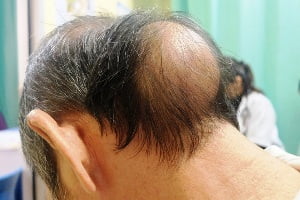
Alopecia areata is autoimmune: the immune system attacks the follicles. It appears as patches, or as the more extensive alopecia totalis and universalis. The AAD notes that “for many people, their hair regrows on its own without treatment,” and that hair loss “can stop for long periods or come and go.” The National Alopecia Areata Foundation is blunt: “there is no way to predict the pattern of hair loss and regrowth or how severe or long-lasting it will be.”
The AAD lists three JAK inhibitors FDA-approved for severe alopecia areata: baricitinib and deuruxolitinib for adults, and ritlecitinib from age 12. All are specialist decisions taken with a dermatologist.
Likely to be permanent
Scarring (cicatricial) alopecias develop, in the AAD’s words, “when inflammation destroys hair follicles,” after which the follicle “is replaced by scar tissue.” The consequence is just as plain: “once a hair follicle is destroyed, it cannot regrow a hair.” Early treatment can stop the area spreading, so prompt dermatology referral matters. But for hair already lost to scarring, coverage is not a stopgap. It is the long-term answer.
Scalp cooling: real, useful, not for everyone
If chemotherapy is the cause, ask about scalp cooling before your first cycle. Cancer Research UK describes wearing a cold cap to lower the scalp’s temperature and reduce blood flow, so that “with less of the cancer drugs getting to the hair follicles, the hair is less likely to die off and fall out.”
It is not a guarantee. Cancer Research UK is explicit: “scalp cooling only blocks certain chemotherapy drugs and doesn’t work for everyone. So you might still have hair thinning or lose your hair completely.” Nor is it offered to everyone. It is generally unsuitable for people with leukaemia or lymphoma, those having scalp radiotherapy, people with certain cold-sensitivity conditions, and those on continuous chemotherapy pumps or tablets.
The deciding variable is time, not efficacy
Drug treatments for hair loss work over months, and several of the causes above do not respond to them at all. Surgery is no faster, and a transplant is inappropriate while the underlying cause is still active. That is a dermatologist’s conversation for later, not a plan for a fortnight from now.
So for a patient with a start date, efficacy is not the question. Lead time is.
That is where the difference between made-to-order and off-the-shelf becomes practical rather than commercial. Custom hair systems are built to your measurements and take time to produce; stock units are manufactured in advance in standard sizes and held in storage, which is why ready-to-ship hair pieces for men can dispatch in roughly 3 to 5 business days to well over 180 countries, and generally cost less than a bespoke equivalent.
A standard stock unit is around 8 by 10 inches and can be cut smaller; bases range from thin skin and full French lace to monofilament, hybrid and 0.06mm ultra-thin skin, in real human hair. None of this treats or affects any illness. It covers, on a timescale that matches a treatment calendar. Macmillan and the American Cancer Society both advise arranging it before your hair falls out, so colour and style can be matched to your own.
Scalp care, and the adhesive conversation you must have
Skin where hair has been lost, Macmillan warns, “may be more sensitive or tender than skin on other parts of your body.” It recommends SPF 30 or higher on the scalp outdoors, covering your head in cold weather, gentle fragrance-free products, and taking a wig off periodically.
There is a second issue during chemotherapy: the National Cancer Institute notes that at points in each cycle your neutrophil count is particularly low and infection risk is raised, and that any scrape or cut should be cleaned carefully. Adhesives sit directly on that skin.
So do not apply adhesive or tape to your scalp during chemotherapy without raising it with your oncology team first. If they advise against it, non-adhesive options exist: clip-attached pieces, a comfort cap worn underneath, or a full wig needing no attachment at all.
Ask whether it will be paid for, before you pay
In the UK, Macmillan Cancer Support states that “in Wales, Scotland and Northern Ireland, you can get a wig free on the NHS,” while “some people can get a wig free on the NHS in England, but others may need to pay.” The NHS lists free eligibility in England as including people under 16, those aged 16 to 18 in full-time education, hospital inpatients, people on qualifying benefits or low incomes, HC2 certificate holders, and some war pensioners. Cancer treatment is not by itself a qualifying criterion in England, so check your own circumstances.
In the US, the American Cancer Society advises: “Ask your insurance company if they cover cranial prostheses for medical hair loss (alopecia). Many insurance companies require a letter or prescription from your doctor.” Some cover part or all; others reimburse after purchase. Get the prescription wording right: “cranial prosthesis,” not “wig.”
Questions to ask your care team
- Is hair loss expected with my drugs or radiotherapy field, and when would it start?
- Is my hair loss likely to be temporary, unpredictable, or permanent?
- Am I suitable for scalp cooling, and is it available here?
- Can you write me a prescription or letter for a wig or cranial prosthesis?
- Is it safe to use adhesive or tape on my scalp during treatment?
Frequently asked questions
Will my hair definitely grow back after chemotherapy?
For most people it does. Cancer Research UK says hair “should return within 3 to 6 months after your treatment ends,” though texture and colour may differ and some drugs delay it. Permanent loss is uncommon.
Should I wait to see if my hair grows back first?
If your loss is likely temporary, a stock piece is a bridge, not a commitment. If it is a scarring alopecia, the hair will not return, and waiting only delays feeling like yourself again.
Can I wear a hairpiece during chemotherapy, and does it affect regrowth?
Many people do, but check the attachment method, because adhesives go onto skin that may be tender and more vulnerable to infection, so raise it with your oncology team first. A hairpiece does not treat, prevent or influence any underlying condition. It covers.
Do I need a hospital wig service, or can I buy one myself?
Either. Many hospitals run a wig service and can fit you there; buying directly is often faster, and a hairdresser can cut a stock piece to suit.
Share this article


Latest Posts




ADVERTISEMENT