

IGF-1 LR3 and Muscle Repair: What Researchers Know
- Updated on: Nov 26, 2026
- 8 min Read

Shahid is a pharmacologist with masters in pharmaceutical sciences and pharmacology. In the past, he worked for Maxinov Healthcare Research Division and R.P Biotech. At DiseaseFix, he is a content guide and writer. He is also associated as a researcher with Integrated Resources Pvt Ltd. currently. Shahid’s areas of interests include cellular and molecular pharmacology, pre-clinical screening, and systemic and clinical Pharmacology.
- Published on Nov 26, 2026
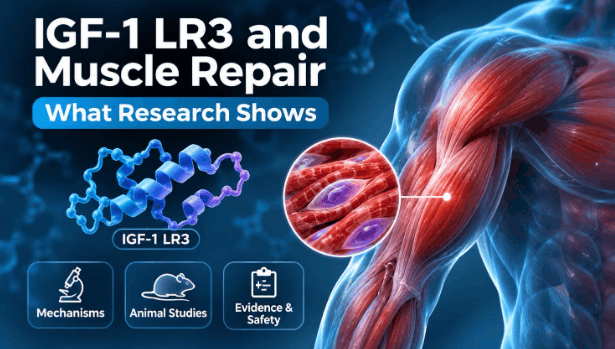
Insulin-like growth factor 1 (IGF-1) is involved in cell growth, development and tissue maintenance. In skeletal muscle, researchers have investigated its role in protein synthesis, muscle stem cell activity and tissue regeneration.
IGF-1 LR3, also known as Long R3 IGF-1, is an engineered analogue of IGF-1. Its modified structure reduces its interaction with IGF-binding proteins, which normally regulate IGF-1 activity. This property has made it useful in laboratory and animal research investigating growth-related signalling.
ADVERTISEMENT
ADVERTISEMENT
Researchers have explored whether IGF-1 LR3 Peptide could influence muscle growth and repair. However, its biological activity should not be confused with proven clinical benefits.
Most research specifically involving IGF-1 LR3 comes from laboratory and animal studies. Human clinical evidence establishing its safety or effectiveness for muscle repair is lacking.
This article examines what researchers have found, how IGF-1 LR3 differs from native IGF-1 and what remains unknown.
What Is IGF-1 LR3?
IGF-1 LR3 is a modified analogue of insulin-like growth factor 1. It contains 83 amino acids, compared with 70 in mature human IGF-1.
Its structure includes two main changes:
- A 13-amino-acid extension at the N-terminus.
- An arginine substitution for glutamic acid at position 3.
These modifications reduce its affinity for IGF-binding proteins (IGFBPs), which normally bind IGF-1 and regulate its availability. IGF-1 LR3 retains the ability to interact with the IGF-1 receptor, making it useful in experimental studies of IGF-related signalling.
The analogue was developed primarily for research applications, including cell-culture studies. Its altered molecular properties do not establish that it improves muscle recovery or growth in people.
IGF-1 LR3 Is Not the Same as Mecasermin
IGF-1 LR3 Peptide should not be confused with mecasermin, the recombinant form of human IGF-1 used in the prescription medicine Increlex.
Mecasermin is FDA-approved for treating growth failure in specific paediatric patients with severe primary IGF-1 deficiency or growth hormone gene deletion with neutralising antibodies to growth hormone.
The two molecules are different. Clinical findings and prescribing information for mecasermin cannot automatically be applied to IGF-1 LR3.
How Does IGF-1 Signalling Relate to Muscle Repair?
Research involving native IGF-1 has helped explain how growth-factor signalling may influence skeletal muscle. These mechanisms provide biological context for LR3 research, but they are not proof that the analogue produces the same effects in humans.
Three areas are particularly relevant.
Muscle Protein Synthesis
IGF-1 signalling can activate pathways involving phosphoinositide 3-kinase (PI3K) and protein kinase B (Akt). These pathways interact with the mammalian target of rapamycin (mTOR), which helps regulate protein synthesis and cellular growth.
Because muscle protein synthesis contributes to muscle adaptation, researchers have studied these pathways in relation to hypertrophy.
However, changes in molecular signalling do not necessarily translate into larger muscle fibres, greater strength or improved recovery.
Satellite Cell Activity
Satellite cells are specialised muscle stem cells located alongside muscle fibres. Following injury, they can become activated, multiply and contribute to muscle regeneration.
Native IGF-1 signalling has been investigated for its role in satellite cell activity and muscle repair. Researchers are interested in how these processes contribute to the restoration of damaged muscle tissue.
Muscle Regeneration
Muscle repair involves several coordinated processes, including inflammation, removal of damaged tissue, cellular regeneration and restoration of muscle function.
IGF-1 is one of several growth factors involved in this complex process. Its effects depend on factors such as tissue location, biological conditions and the type of injury being studied.
Research on these pathways helps explain the scientific interest in IGF-1 LR3. It does not establish that LR3 improves muscle regeneration in people.
What Have Animal Studies Found?
Research specifically involving IGF-1 LR3 is mainly preclinical. The findings vary according to the animal model, experimental conditions and outcome measured.
A 2001 Rat Study: Muscle Protein Was Not Preserved
A study by F. M. Tomas, published in Growth Hormone & IGF Research in 2001, investigated whether LR3 IGF-I could reduce lean-tissue loss during food restriction in young and adult rats.
The researchers found that LR3-treated rats maintained higher body weight and nitrogen retention than control animals. However, these changes did not mean that skeletal muscle protein was preserved.
In adult rats, LR3 treatment was associated with increased protein breakdown and reduced protein synthesis under the study conditions.
The findings showed that an increase in body weight does not necessarily indicate muscle preservation.
What this study tells researchers: LR3 did not prevent muscle protein loss during short-term food restriction in this rat model. The study did not investigate recovery from a muscle injury.
A 2013 Mouse Study: Local IGF-1 Expression and Muscle Recovery
A 2013 study by Ye and colleagues investigated whether local IGF-1 overexpression could influence muscle damage and recovery following disuse in mice.
Researchers increased IGF-1 expression in skeletal muscle and examined the effects of immobilisation and subsequent reloading. The treated muscles showed less evidence of reloading-related damage and faster recovery of muscle force compared with control muscles.
The findings suggest that local IGF-1 signalling may influence muscle regeneration in this animal model.
However, this study investigated local overexpression of native IGF-1 through gene delivery. It did not administer IGF-1 LR3.
The distinction matters because evidence involving native IGF-1 cannot be used as direct evidence of LR3 effectiveness.
What this study tells researchers: Native IGF-1 may influence muscle recovery in mice, but the findings do not establish a similar effect from IGF-1 LR3.
A 2025 Fetal Sheep Study: Growth and Safety Findings
A study published in the American Journal of Physiology-Endocrinology and Metabolism in 2025 examined IGF-1 LR3 in late-gestation fetal sheep with growth restriction caused by placental insufficiency.
Researchers compared LR3 treatment with a vehicle control over approximately one week. They found no significant improvement in fetal body weight, insulin concentrations, glucose levels or glucose-stimulated insulin secretion.
The study also reported a reduction in circulating amino acids, including branched-chain amino acids, in the LR3 group.
Importantly, four fetal deaths were associated with LR3 treatment. The affected animals showed hypoglycaemia and hypoxaemia. The researchers discussed these findings as a potential safety concern within the experimental model.
This was a specialised fetal-growth study, not a muscle-repair trial. Its findings cannot establish the risks of IGF-1 LR3 in humans. However, they demonstrate why its biological effects and safety require further investigation.
What this study tells researchers: LR3 did not improve fetal growth in this model, and the observed adverse outcomes raise questions that require careful investigation.
A 2026 Rat Study: IGF-1 LR3 in Volumetric Muscle Loss
A particularly relevant study was published in the Journal of Surgical Research in January 2026.
Researchers investigated IGF-1 LR3 delivered through a synthetic hydrogel muscle void filler in a rat model of volumetric muscle loss (VML). VML involves substantial loss of skeletal muscle tissue, often following severe traumatic injuries.
The researchers compared different formulations containing soluble or poly(lactic-co-glycolic acid) (PLGA)-encapsulated LR3 with a control group.
The high-dose, PLGA-encapsulated LR3 formulation produced increased muscle weight at 28 days compared with the control group.
However, the researchers found no significant differences in maximum torque production or specific torque between the experimental groups. Histological analysis also showed no improvement in muscle fibre size, fibre count or fibrosis.
The authors concluded that adding IGF-1 LR3 to the muscle void filler did not improve neuromuscular function or muscle fibre hypertrophy.
This result is important because it shows why increased tissue weight should not automatically be interpreted as improved muscle recovery.
What this study tells researchers: Direct LR3 research in a severe muscle-injury model did not demonstrate improved muscle function or fibre hypertrophy.
Why Muscle Weight Does Not Prove Muscle Repair
One important consideration in IGF-1 LR3 research is the difference between muscle weight, muscle structure and functional recovery.
These measurements describe different outcomes:
- Muscle weight: Measures the mass of the examined tissue.
- Muscle fibre size: Assesses the cross-sectional area of individual muscle fibres.
- Muscle force or torque: Measures the ability of muscle to generate force.
- Fibrosis: Measures the formation of excess connective tissue during repair.
- Histological analysis: Examines tissue structure and cellular changes.
A study may report a change in one measurement without showing improvement in the others.
The 2026 rat study illustrates this distinction. Although one LR3 formulation increased muscle weight, the researchers did not find corresponding improvements in muscle fibre hypertrophy or measured muscle function.
For this reason, muscle-repair research needs to consider structural and functional outcomes rather than relying on tissue weight alone.
Is There Human Research on IGF-1 LR3?
There is currently no established human clinical evidence demonstrating that IGF-1 LR3 improves muscle repair, muscle growth or physical performance.
Research specifically involving LR3 has primarily used laboratory systems and animal models. Human studies involving native IGF-1 or mecasermin do not establish the safety or effectiveness of this modified analogue.
Several important questions remain unanswered:
- Does IGF-1 LR3 improve muscle repair in people?
- Does it produce measurable changes in muscle size or strength?
- What are its effects on blood glucose regulation?
- What are its short- and long-term safety implications?
- How do its effects vary across different tissues and biological conditions?
Without controlled human trials, researchers cannot establish its clinical effectiveness, appropriate medical use or human safety profile.
Safety and Regulatory Considerations
The absence of human clinical evidence creates important uncertainties about IGF-1 LR3.
IGF-1 signalling influences several biological processes, including cell growth, survival and metabolism. These effects are not limited to skeletal muscle.
The 2025 fetal sheep study reported hypoglycaemia, hypoxaemia and fetal deaths associated with LR3 treatment in its experimental model. These findings should not be interpreted as a confirmed human adverse-effect profile, but they highlight the importance of investigating metabolic and systemic effects.
IGF-1 signalling is also relevant to cancer biology because it participates in pathways involved in cellular growth and survival. This makes the long-term effects of altered IGF-1 receptor activity an important research question. However, current evidence does not establish that IGF-1 LR3 causes cancer in humans.
FDA Status and Mecasermin
IGF-1 LR3 is not an FDA-approved medicine.
Mecasermin (Increlex), by contrast, is an approved recombinant human IGF-1 medicine for a specific paediatric growth-failure indication. Its prescribing information includes warnings about hypoglycaemia, hypersensitivity reactions, intracranial hypertension and malignant neoplasia.
These warnings apply to mecasermin and should not be presented as a confirmed adverse-effect profile for IGF-1 LR3. The two molecules have different structures and clinical evidence bases.
An FDA substance-identity record, where one exists, should also not be interpreted as approval of a medicine.
IGF-1 and its analogues are included in the World Anti-Doping Agency (WADA) Prohibited List under S2, which covers peptide hormones, growth factors, related substances and mimetics. The relevant category is growth factors and growth factor modulators.
The 2026 Prohibited List remains in effect until December 31, 2026. WADA has also published its 2027 list, which takes effect on January 1, 2027 and retains the prohibition of IGF-1 and its analogues.
The substance is therefore relevant to anti-doping rules both in and out of competition. Athletes should check the current list and seek guidance from their relevant anti-doping organisation when necessary.
What Researchers Still Need to Investigate
Current research provides information about IGF-1 signalling and the biological properties of LR3. However, important evidence gaps remain.
Future studies need to establish:
- Whether LR3 produces measurable improvements in muscle repair in relevant injury models.
- Whether changes in tissue weight correspond to improvements in muscle fibre structure and function.
- How different delivery systems influence its biological activity.
- Whether findings can be reproduced across different experimental models.
- What metabolic and systemic effects occur during longer-term exposure.
- Whether any experimental findings have relevance to human clinical outcomes.
Researchers must also distinguish LR3 from native IGF-1 and other modified IGF compounds. Findings from one molecule should not be treated as evidence for another without direct testing.
Frequently Asked Questions
What is IGF-1 LR3?
IGF-1 LR3 is a modified IGF-1 analogue with a 13-amino-acid extension and an arginine substitution.
Does IGF-1 LR3 repair damaged muscles?
Human evidence does not establish this. A 2026 rat study found no improvement in muscle function or fibre growth.
Is IGF-1 LR3 the same as mecasermin?
No. Mecasermin is recombinant human IGF-1, while IGF-1 LR3 is a modified analogue.
Has IGF-1 LR3 been studied in humans?
Human clinical evidence on its safety and effectiveness remains insufficient.
Is IGF-1 LR3 FDA-approved?
No. IGF-1 LR3 is not an FDA-approved medicine.
Final Thoughts
IGF-1 is an important part of skeletal muscle research because of its involvement in protein synthesis, satellite cell activity and tissue regeneration. These biological processes have helped researchers understand how muscle responds to injury and physical stress.
IGF-1 LR3 has also been investigated in experimental models. However, findings from the 2001 rat study, 2025 fetal sheep study and 2026 volumetric muscle-loss study do not establish a consistent muscle-repair benefit. The 2013 mouse study provides useful information about native IGF-1 signalling, but it should not be treated as direct evidence for LR3.
At present, there is insufficient human evidence to establish IGF-1 LR3 as a safe or effective approach to muscle repair. Further research is needed to understand its biological effects, safety profile and potential clinical relevance.
Share this article


Latest Posts




ADVERTISEMENT