

Why Medical Devices Take Long to Reach Patients and How Expert Engagement Changes That
- Updated on: Apr 28, 2026
- 3 min Read

Mohd Sadiq is a bioinformaticist with a special interest in Nanotechnology. He completed his Master’s degree from Jamia Millia Islamia University, New Delhi, followed by an internship in the Department of Plant Molecular Biology, University of Delhi, South Campus. Mohd Sadiq has also worked at Codon Biotech Pvt. Ltd. Noida.
By
- Published on Apr 28, 2026
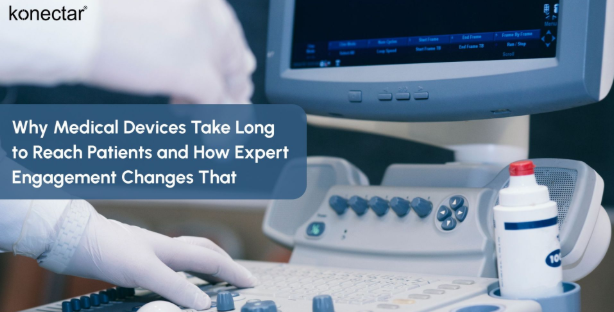
A medical device that could improve a patient’s life sits approved in a lab while the clock ticks. This is not rare. It is the default reality of medical device development. Understanding why the medical device approval process stretches across years is the foundation for doing something about it.
Bringing a high-risk medical device from concept to market typically takes 7–10 years. The regulatory burden is significant, with the PMA (Premarket Approval) pathway costing an estimated $31 million or more on average. Even then, the process is rarely straightforward. Around 60% of FDA submissions receive at least one major information request, adding further delays and complexity.
ADVERTISEMENT
ADVERTISEMENT
Why the medical device regulatory approval timeline is uniquely complex
Medical devices are not pharmaceuticals. They span everything from a glucose sensor to a spinal implant to an AI-powered diagnostic system. Regulators must apply consistent safety standards to technologies that are fundamentally different from one another and that evolve faster than the frameworks used to evaluate them.
The approval pathway for Class III high-risk devices demands rigorous clinical evidence of safety and effectiveness. Companies targeting different markets face compounding timelines not parallel ones. Here’s a realistic look at the medical device regulatory approval timeline
- Phase 1: Preclinical Development and Design Validation
Includes bench testing, biocompatibility studies, and software verification. This phase typically spans 12–24 months and establishes the foundation for subsequent development.
- Phase 2: Regulatory Pathway Selection and Pre-Submission
Determining the appropriate regulatory pathway (e.g., 510(k), De Novo, PMA) is a critical early step. Pre-submission interactions can help align on requirements and expectations.
- Phase 3: Clinical Trial Design and IRB Approval
Medical device trials often focus on functional endpoints and require careful protocol design. Institutional approvals are essential before study initiation.
- Phase 4: Enrollment, Data Collection, and Monitoring
Successful study execution depends on effective site selection, patient enrollment, and ongoing data monitoring across study locations.
- Phase 5: Submission, Review, and Approval
Regulatory review timelines vary depending on the pathway and submission completeness. Ongoing communication with regulatory bodies supports a smoother review process.
The hidden bottleneck
Regulatory challenges in medical devices often trace back to one gap. Companies consistently cite regulatory complexity as their primary obstacle. But when actual timelines are examined closely, a recurring root cause emerges: insufficient clinical expertise at decision-critical moments.
Designing a credible trial requires knowing which endpoints regulators will accept, which patient populations are defensible, and what safety signals investigators will scrutinize. This knowledge does not live in guidance documents; it lives with practicing clinicians, specialist KOLs, and former reviewers.
The expertise gap is measurable. A sponsor without the right clinical advisor may spend 18 months designing a study that an experienced interventional cardiologist or neurosurgeon could have redirected in a focused workshop. Access to the right expert at the right moment is one of the most underappreciated levers for speeding up medical device approval.
Solution: Find the right clinical expert before the timeline slips
konectar AI-powered platform connects medtech companies with verified clinical specialists, KOLs, and regulatory advisors who accelerate your path from concept to approval.
By enabling teams to identify relevant investigators based on real-world trial experience and institutional affiliations, there’s a better alignment between study design and execution from the outset.
Early expert involvement also improves site selection, minimizes protocol amendments, and strengthens regulatory readiness. At the same time, maintaining a centralized view of investigator profiles, past collaborations, and engagement history helps teams stay coordinated and avoid duplication of effort. This reduces reliance on fragmented systems and improves cross-functional visibility.
Additionally, mapping expert networks across geographies, along with associated hospitals and research centers, allows for more strategic collaboration and efficient trial planning.
Ultimately, engaging the right clinical experts early, and managing those relationships systematically, creates a more predictable and efficient path from development to patient access.
Closing thoughts
Speeding up medical device approval is a strategy, not a shortcut. The companies that move fastest invest early in three areas: choosing the right regulatory pathway from day one, designing clinically credible trials before the study starts, and building expert access as a capability not an afterthought.
Share this article



Latest Posts





ADVERTISEMENT