


Why Walkie-Talkies Still Play a Role in Modern Healthcare Communication
- Updated on: May 16, 2026
- 4 min Read

Monika Singh is an expert in computer sciences and has pursued her Master’s degree (M.Tech-CS) from Banasthali University, Rajasthan. Her areas of interest include data structure, software engineering, software testing, and computer graphics. Monika Singh has published a paper on “Modified AODV in MANET,” International Journal of Computer Science and Management Studies (IJCSMS), ISSN: 2231-5268, Vol-14, Issue-05 May 2014, PP:12-18.
By
- Published on May 16, 2026
The hallway was already loud before the overhead page hit.
A transport team needed assistance downstairs. Security was responding to an issue near the emergency entrance. Two nurses were coordinating a patient transfer while a doctor speed-walked through the corridor carrying the kind of expression that says, “I haven’t sat down in six hours.”
ADVERTISEMENT
ADVERTISEMENT
Then somebody’s phone froze.
Of course it did.
Hospitals are strange ecosystems. Everything moves fast, everybody multitasks constantly, and no one has time for communication delays caused by weak signals, missed notifications, or apps demanding another software update right now for some reason.
That’s exactly why the walkie-talkie still holds a place inside modern healthcare communication, despite all the advanced technology hospitals use every day.
Because when things get chaotic, simple communication suddenly becomes very attractive.
Hospitals Run on Organized Chaos
People imagine hospitals as highly controlled environments.
And technically, yes. They are.
But they’re also nonstop moving systems filled with urgency, interruptions, and tiny operational decisions happening every second. Nurses coordinate patient care. Security monitors entrances. Maintenance responds to equipment issues. Emergency teams move quickly between departments while transport staff somehow manage to push beds through hallways packed with people moving in every direction at once.
It’s controlled chaos wearing scrubs.
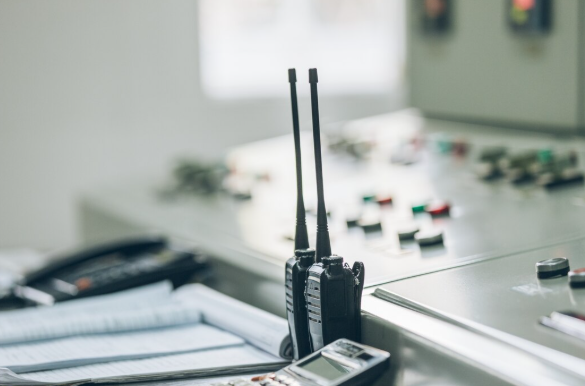
A walkie-talkie works well in healthcare because it cuts directly through communication clutter. No unlocking screens. No digging through messages. No missed calls because someone’s phone was buried under paperwork or inside protective gear.
Push button. Speak instantly. Get response immediately.
Honestly, that simplicity feels almost luxurious in modern healthcare environments.
Phones Aren’t Always Practical, Or Fast Enough
Smartphones are useful right up until reality gets involved.
Healthcare workers wear gloves. Carry equipment. Move patients. Sanitize constantly. Run between departments. In emergency situations, nobody wants to stop and scroll through notifications looking for the correct message thread while alarms are going off nearby.
That’s where the walkie-talkie quietly outperforms more “advanced” communication tools.
Need transport support? Call instantly. Security issue? Immediate communication. Maintenance emergency? One quick transmission and someone responds.
Fast communication matters because healthcare delays have a nasty habit of multiplying. One small slowdown creates another. Then another. Suddenly an entire department feels backed up because communication lagged for thirty seconds longer than it should have.
Hospitals don’t really have spare time lying around.
Emergency Situations Change the Rules Completely
During emergencies, communication stops being convenient and starts becoming critical.
And hospitals know this better than almost anyone.
Power outages. Severe weather. Patient surges. Security incidents. Emergency response situations. In high-pressure environments, communication systems need to function immediately and reliably without depending entirely on overloaded phone networks or fragile infrastructure.
That’s part of why many healthcare facilities still rely on walkie-talkie systems for rapid coordination.
Because during emergencies, nobody wants to hear:
“Sorry, I didn’t get the message.”
Or worse:
“My phone died.”
Direct push-to-talk communication eliminates delay. Security teams coordinate faster. Emergency staff move quicker. Departments stay connected even when everything else feels slightly out of control.
Which, in healthcare, happens more often than people realize.
Hospitals Are Basically Small Cities
Modern hospitals are enormous.
Multiple floors. Separate wings. Parking structures. Surgical departments. Emergency entrances. Loading docks. Intensive care units tucked deep inside maze-like corridors that somehow all look identical after hour ten of a shift.
Communication across those spaces becomes surprisingly difficult.
And thick concrete walls? Terrible for cell signals, by the way.
A walkie-talkie solves part of that problem by giving healthcare teams immediate communication across departments without relying entirely on traditional phone coverage. Staff coordinate patient transport, security concerns, maintenance issues, and logistical updates much faster when communication stays direct and uninterrupted.
Also, and this feels important, nobody working a twelve-hour shift wants to chase weak Wi-Fi signals around a hospital basement.
Security Teams Depend on Instant Communication
Healthcare security is not subtle work.
Security staff manage entrances, behavioral incidents, emergency situations, restricted areas, parking problems, visitor coordination, and patient safety simultaneously. Situations evolve quickly, often with very little warning.
Delayed communication creates real problems.
That’s why security teams continue relying heavily on walkie-talkie systems. Communication stays immediate, mobile, and reliable even during crowded events, emergencies, or high-traffic periods where phone systems become less efficient.
Plus, direct communication simply works better when people are actively moving throughout large facilities.
There’s no “Hang on, let me call you back.”
Things are already happening.
Modern Walkie-Talkies Quietly Got Smarter
A lot of people still imagine walkie-talkies as giant plastic radios from old movies where every conversation sounded like it was happening inside a microwave.
Modern systems look very different.
Today’s walkie-talkie technology often includes digital audio clarity, encrypted communication, noise reduction, long-range connectivity, weather resistance, and nationwide push-to-talk functionality that works far beyond traditional radio limitations.
The technology evolved dramatically while keeping the one thing healthcare environments care about most:
Reliability.
Not flashy features. Not trendy apps. Just communication that works consistently under pressure.
Funny how valuable that becomes once things get busy.
Healthcare Still Depends on Human Communication
Medicine may rely on advanced equipment, digital records, and increasingly sophisticated systems, but hospitals still run on people coordinating with other people in real time.
That part hasn’t changed.
Patients move. Emergencies happen. Situations escalate quickly. Teams need information fast without unnecessary friction slowing them down.
That’s why the walkie-talkie still matters in modern healthcare communication. It solves a very old problem in a very practical way: helping people stay connected when speed, clarity, and reliability matter more than anything else.
And honestly, in a hospital, they usually do.
Share this article


Latest Posts




ADVERTISEMENT