


5 Qualities to Evaluate Before Choosing an Eye Surgeon for Vision Correction
- Updated on: Jul 6, 2026
- 3 min Read

- Published on Jul 6, 2026
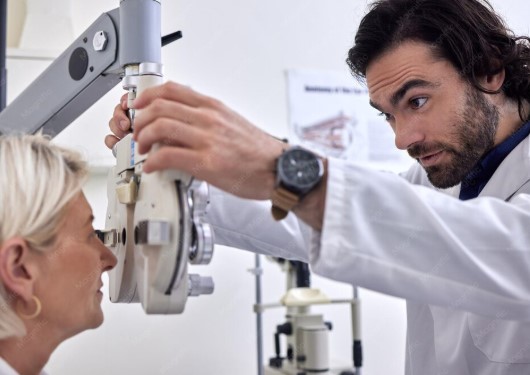
Choosing a surgeon for vision correction is one of the more consequential decisions a person can make about their health. The eyes are irreplaceable, and the results of refractive surgery, whether LASIK, PRK, or another procedure, are meant to last a lifetime.
Most people spend more time researching a new phone than they do evaluating the surgeon who will permanently alter how they see the world. In Chicago and across the country, patients who take the time to assess the right qualities before committing tend to have significantly better experiences and outcomes than those who choose based on price or convenience alone.
ADVERTISEMENT
ADVERTISEMENT
Here is what actually matters when evaluating an eye surgeon for vision correction.
1. Board Certification and Fellowship Training in the Right Specialty
Not every ophthalmologist is equally qualified to perform vision correction surgery. General ophthalmologists can legally offer refractive procedures, but surgeons who have completed a cornea or refractive surgery fellowship have a level of specialized training that goes considerably deeper. That fellowship involves focused study of the anterior segment of the eye, including the cornea, lens, and surrounding structures, which is precisely what vision correction surgery involves.
Board certification is a baseline requirement, but it’s the fellowship training on top of that which signals genuine subspecialty expertise. When evaluating credentials, look specifically for fellowship training in cornea or refractive surgery rather than stopping at general board certification.
2. Procedural Volume and Years of Focused Experience
Experience in refractive surgery is measured in procedures, not just years. A surgeon who has been practicing for twenty years but performs only occasional LASIK cases has a fundamentally different skill level than one who has performed thousands of procedures with consistent focus on vision correction. Volume builds the kind of pattern recognition and technical judgment that can’t be gained from textbooks or occasional practice.
When searching for an eye surgeon Chicago, asking directly about the number of procedures performed and how long the surgeon has been focusing specifically on refractive surgery gives a clearer picture than any credentials alone. Subspecialty practices like Chicago Cornea Consultants usually concentrate their work in cornea and refractive care, which means their surgeons accumulate the kind of focused procedural volume that translates into more predictable outcomes for patients.
3. The Thoroughness of the Pre-Surgical Evaluation
A good surgeon doesn’t agree to operate on every patient who walks in wanting LASIK. The pre-surgical evaluation is where candidacy is determined, and it involves a detailed assessment of corneal thickness, topography, pupil size, tear film quality, and overall eye health. Patients who aren’t suitable candidates for one procedure may be better served by an alternative. Identifying that alternative before surgery is the mark of a practice that prioritizes outcomes over volume.
In short, comprehensive pre-operative screening is one of the most important factors in achieving safe and effective refractive surgery outcomes. A surgeon or practice that rushes through the evaluation or doesn’t discuss alternatives when a patient isn’t an ideal candidate for their first choice is one worth reconsidering.
4. Technology and Equipment Used in the Practice
Refractive surgery outcomes are directly influenced by the technology used to plan and perform the procedure. Wavefront-guided laser systems, advanced corneal topography mapping, and femtosecond lasers for flap creation have all improved outcomes compared to earlier generations of equipment. A practice that hasn’t updated its technology in a decade is operating with tools that don’t reflect the current standard of care.
Asking which specific laser system a practice uses, and whether it includes wavefront or topography-guided customization, is a reasonable and important question. The answer tells you something meaningful about both the investment the practice has made in outcomes and the level of personalization available in your treatment plan.
5. How the Surgeon Communicates Risks and Realistic Expectations
This quality is harder to quantify but just as important as credentials or technology. A surgeon who presents vision correction as universally safe and uncomplicated is not giving you the full picture. Every surgical procedure carries risk, and refractive surgery is no exception. Dry eye, halos, glare, undercorrection, and the possibility of needing an enhancement are all real outcomes that a thorough surgeon will discuss openly before you consent to anything.
Research has shown that individualized pre-operative information can enhance patient satisfaction in refractive surgery, with patients who received detailed risk and outcome counseling reporting higher satisfaction regardless of the technical result. A surgeon who takes time to walk through both the likely outcomes and the less likely ones is demonstrating the kind of honesty that should factor into your decision as much as any credential.
Final Words
Vision correction surgery done well can be genuinely life-changing. Done by the wrong surgeon or without thorough evaluation, it can create problems that are difficult or impossible to reverse. The five qualities above aren’t a checklist to rush through.
They’re a framework for understanding whether the surgeon sitting across from you has the training, the tools, the process, and the honesty to give your eyes the best possible outcome.
Share this article


Latest Posts





ADVERTISEMENT