

Hyaluronic Acid vs Bellafill for Penile Girth Enhancement: One Dissolves, One Doesn’t
- Updated on: Nov 27, 2026
- 11 min Read

Mohd Sadiq is a bioinformaticist with a special interest in Nanotechnology. He completed his Master’s degree from Jamia Millia Islamia University, New Delhi, followed by an internship in the Department of Plant Molecular Biology, University of Delhi, South Campus. Mohd Sadiq has also worked at Codon Biotech Pvt. Ltd. Noida.
By
- Published on Nov 27, 2026
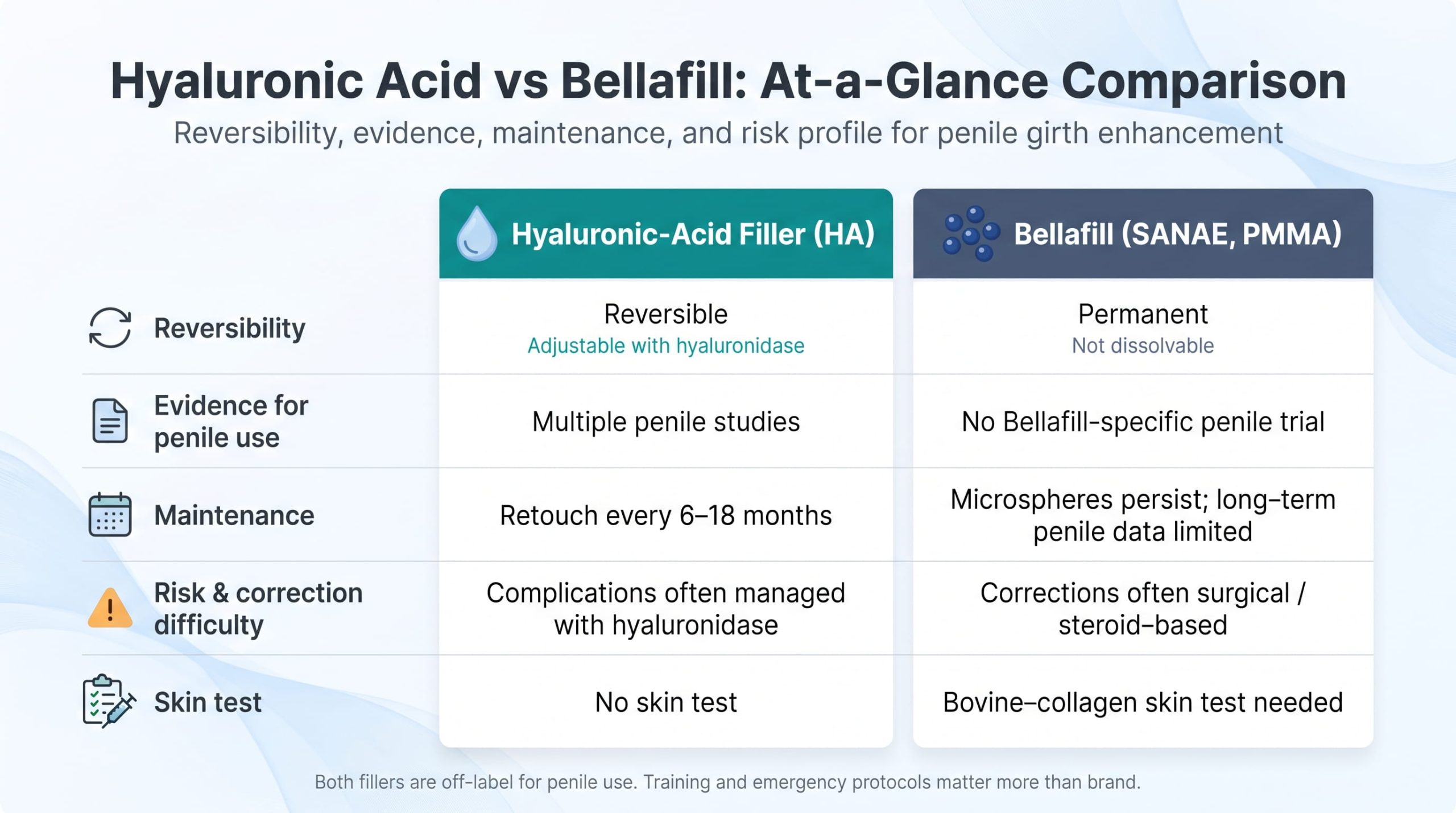
You’re here to compare two off-label injectables for penile girth enhancement: hyaluronic-acid (HA) gel and Bellafill, recently rebranded as SANAE, a PMMA filler. Neither product is FDA-approved for the penis, and neither will add length or treat erectile dysfunction. HA delivers adjustable volume that clinicians can reduce with hyaluronidase, whereas Bellafill locks permanent microspheres in place after a mandatory bovine-collagen skin test. This guide weighs the evidence, risks, costs and key questions so you can choose the durability-versus-flexibility route that feels right for you.
Hyaluronic acid vs Bellafill: the quick comparison
Need a fast side-by-side comparison? Start with this snapshot, then read on for study details and caveats.
ADVERTISEMENT
ADVERTISEMENT
| Factor | Hyaluronic-acid filler | Bellafill (now marketed as SANAE) |
| FDA status for penile use | Off-label | Off-label |
| Material | Cross-linked HA gel the body gradually degrades | 20 percent PMMA microspheres suspended in 80 percent bovine-collagen carrier with lidocaine |
| Reversibility | Often reduced with hyaluronidase enzyme | Not dissolvable; corrections are typically surgical |
| Penile-specific evidence | Multiple randomized and prospective studies | No Bellafill-specific penile trial, only class-level PMMA data |
| Expected maintenance | Retouch every 6-18 months | Microspheres persist; long-term penile data still limited |
| Skin test required | No | Yes, a bovine-collagen skin test four weeks before injection |
| Key risks | Swelling, bruising, nodules, migration, infection | All HA risks plus delayed nodules or granuloma; harder removal |
“FDA-approved filler” refers to facial indications, not shaft injections. Any provider offering penile filler is working off-label, so their training, technique and emergency plan matter more than the brand on the syringe.
Multidisciplinary clinics, such as Contemporary Health Center led by Dr. Richard L. Bloy, may offer both HA and PMMA options. Its publicly available guide notes that most patients need about 6-15 syringes to gain roughly 20-35 percent in circumference, figures you can pair with the table above when deciding on product, total volume and contingency plan.
Bellafill’s trade name officially changed to SANAE in August 2026; many consent forms still list the legacy name, so watch for both.
How hyaluronic acid and Bellafill work
Hyaluronic acid adds temporary, adjustable volume
Hyaluronic-acid (HA) filler is a cross-linked gel placed in the loose tissue between the dartos and Buck fascia. Published trials typically use about 15-22 mL per session, averaging 15.2 mL in one multi-center study. The gel binds water immediately, softening the shaft contour without entering the erectile chambers.
Because HA is biodegradable, tissue enzymes trim the material over several months. Ultrasound follow-up shows a gradual taper rather than an abrupt loss. If asymmetry or a palpable ridge appears, clinicians can inject hyaluronidase to break HA into water-soluble fragments the body clears. The drug works best within days to weeks of placement and, like the filler itself, is off-label for penile use, so providers should keep it on site and follow an allergy-screen protocol.
Longevity, firmness and feel vary with the product’s cross-link density and the injection technique. Highly cohesive gels tend to hold shape longer but may feel firmer, while softer blends integrate quickly yet fade sooner. A single-entry cannula pass can minimise bruising; multipuncture needle passes allow finer sculpting but may increase swelling. Discuss volume plan, product choice and contingency steps before the first syringe touches skin.
Bellafill embeds instant volume, plus permanent PMMA microspheres
Each Bellafill (now SANAE) syringe holds 80 percent bovine collagen with lidocaine plus 20 percent polymethyl-methacrylate (PMMA) microspheres 30-50 µm in diameter. The collagen carrier provides the early, mouldable lift and then resorbs over a few months; the microspheres stay indefinitely and become encased in your own collagen.
Because PMMA is non-degradable, the contour set during injection becomes the long-term baseline. Hyaluronidase cannot dissolve it; significant corrections often require intralesional steroids, prolonged antibiotics or surgical excision.
The U.S. label also requires a forearm skin test at least four weeks before treatment to rule out bovine-collagen hypersensitivity. Even after a negative test, discuss scar tendency, lidocaine allergy and how future surgeries (such as penile prosthesis placement or Peyronie’s repair) could be more complex with PMMA in the tissue.
Bellafill’s permanence spares routine top-ups, but it raises the stakes for first-session volume, symmetry and injector skill. Enter only when you are comfortable with a result that cannot be enzymatically reversed.
What the evidence says about girth, satisfaction and feel
Hyaluronic acid has the larger penile-specific evidence base
Most published numbers come from HA studies rather than permanent fillers. Randomized trials, prospective cohorts and single-surgeon audits that follow men for 6-18 months consistently report short-term flaccid-circumference gains of about 1.5-2.5 cm, as shown in a 2026 Springer open-access study. According to a European Association of Urology guideline update in March 2026, HA provides “demonstrable but variable” girth increase with a comparatively favorable safety profile.
A 30-study meta-analysis published in October 2026 pooled 2,554 patients and calculated a mean gain of 1.88 cm (95 % CI 1.53-2.23) but flagged “extreme heterogeneity,” meaning individual results ranged from less than 1 cm to more than 3 cm depending on product, volume and technique.
Minor adverse events (bruising, swelling, transient nodules, limited migration) are common; severe complications remain uncommon when the injector uses sterile technique and the correct depth. Ultrasound studies show filler tapering gradually rather than collapsing; pockets can still be visible at 12 months, yet circumference drifts toward baseline unless a staged top-up is done at 3-6 months.
Almost all trials measure flaccid girth. Erect circumference is harder to standardise, so data are sparse; build expectations around appearance and confidence rather than guaranteed millimetres during intercourse.
PMMA findings cannot automatically be applied to Bellafill
The largest PMMA data set comes from a 2016 series of 729 men treated with Metacrill, a carboxymethyl-cellulose PMMA suspension, not Bellafill. At follow-up, 52 percent reported a palpable or visible irregularity, and only 28 percent completed the long-term questionnaire, limiting confidence in durability figures.
A 2025 comparative study evaluated hyaluronic acid against PMMA and polylactic acid (n = 301). The PMMA arm achieved the largest volumetric gain but recorded the lowest overall satisfaction scores and a higher adverse-event rate (14.3 percent) than HA (7.2 percent). The study is useful for understanding the material class, yet it examines a different formulation, not Bellafill.
So far, no randomized trial or large cohort has tracked Bellafill or SANAE under penile skin. Until such data exist, any discussion of permanence, complication rates or tactile feel for Bellafill must rely on PMMA-class clues drawn from related, but chemically distinct, products.
Realistic interpretation: averages hide the spread
The same 30-study meta-analysis noted above calculated a mean flaccid-girth gain of 1.88 cm but reported an I² value above 85 percent: researcher code for treating the average as a weather forecast, not a promise. Individual studies used 10-30 mL of filler and followed patients for eight weeks to two years, so outcomes scattered widely.
In practice, some men gained more than 3 cm while others saw less than 1 cm. Feel matters, too: HA generally settles soft and skin-like, whereas PMMA retains a firmer edge that some partners notice. Satisfaction surveys lean higher for HA when symmetry and tactile comfort outrank raw size; the permanent group scores higher only when “no annual maintenance” is the top priority.
Bottom line: girth statistics give you a ballpark, not a contract. Your anatomy, filler choice, injection plane and the person holding the cannula ultimately shape the real-world result.
Risks, reversibility and what happens if something goes wrong
A systematic review of 2,620 patients across 23 studies reported an overall complication rate of 14.9 percent for injectable penile-augmentation procedures. HA fillers were numerically lowest at about 9 percent, while PMMA and other permanent materials ranked higher. Numbers aside, any shaft injection can misfire. Understanding what can happen, and how easily it can be fixed, should be part of every consultation.
Shared risks for both fillers
Swelling, bruising, temporary aching and minor asymmetry are common in the first week. More serious events include infection, migration, palpable nodules, phimosis or paraphimosis and, rarely, vascular compromise that can threaten skin viability. Risk rises with higher volumes, multipuncture needle passes and inadequate sterile technique.
What “HA can be dissolved” really means
Hyaluronidase is an enzyme that fragments HA filler so the body can clear it, but its use for correcting cosmetic injections, including penile filler, is off-label, and the FDA notes that no product is formally approved for dermal-filler removal.
- Effectiveness drops as days pass: animal models show little benefit when treatment starts 24 hours or more after injection.
- Multiple sessions may be needed; swelling and extra needle sticks are common.
- Allergy is rare but real, so skin-test blebs or rapid intradermal tests are recommended before full dosing.
Safe use starts with diagnosis. Ultrasound or careful palpation must confirm HA (not infection or haematoma) before injecting the enzyme; putting hyaluronidase into infected tissue risks spreading bacteria. Clinics should keep epinephrine, antihistamine and written protocols on hand, and they should show you the hyaluronidase vial during your visit, because an “undo” option only helps when stocked, labelled and competently delivered.
Why Bellafill complications are harder to reverse
PMMA microspheres in Bellafill or SANAE remain in tissue indefinitely, and enzymes or massage cannot break them down. In the largest PMMA penile series to date, which followed 729 Metacrill patients in 2016, 52 percent reported a palpable or visible irregularity, and some required intralesional steroids or open excision to restore contour. Although that study used a different formulation, it illustrates a class problem: once a nodule forms, correction often means steroids, months of anti-inflammatory drugs or surgery that swaps filler for scar.
Late-onset granulomas can emerge after infection or immune activation even a year later. Stubborn lesions usually need micro-excision through small incisions on tissue you want smooth and sensate.
Permanent beads also complicate future procedures. Surgeons placing a penile prosthesis must tunnel through PMMA-peppered planes, increasing operative time and unpredictability; the same beads can distort graft placement during Peyronie’s curvature repair. No Bellafill-specific penile cohort has quantified these challenges, so patients must rely on broader PMMA evidence when weighing permanence against flexibility.
Warning signs that deserve an urgent call
Most bruising looks worse than it feels, but call your injector or seek emergency care right away if you notice any of these changes:
- Skin that turns white, gray, blue or suddenly darker than surrounding tissue
- Sharp, escalating pain unrelieved by over-the-counter medication or ice
- Heat, redness or swelling that keeps spreading after day 3, especially with fever or chills
- Pus, foul-smelling drainage or a firm, hot lump
- Foreskin that cannot move forward or back (phimosis or paraphimosis)
- New difficulty starting or stopping urine, or burning during urination
Contact the injector first, because they know the exact product, volume and injection plane. If they are unreachable, go to the nearest emergency department and bring your filler details plus any photos from the first hours after treatment. Swift action can save tissue and shorten recovery.
Longevity, maintenance and cost over time
Published U.S. starting prices for HA penile filler typically range from $2,800 to $4,400 per session.
Contemporary Health Center publishes a detailed price menu that breaks costs down by syringe: Restylane HA filler starts at $800 for one syringe or $2,950 for a four-syringe package, while Bellafill runs about $1,500 per 1.5-cc syringe and $10,000 for 12 cc.
Seeing a transparent, per-millilitre menu like this helps you translate glossy “platinum” bundles into hard numbers you can compare across clinics.
Hyaluronic acid requires a maintenance mindset
Prospective data show HA girth gains remain clear for 6-12 months; ultrasound still detected residual gel in 60 percent of men at 48 weeks in a 2026 cohort study that used staged retouching. A larger 595-patient series found circumference tapering steadily over a year, with 44 percent scheduling a top-up within 12 months. The fade is gradual, not abrupt, so gains soften rather than disappear overnight.
Most clinics therefore review results at 3-6 months and add a smaller volume, often 20-40 percent of the initial dose, to smooth edges or refresh symmetry. Because fewer millilitres are used, a maintenance session usually costs less than the first visit, but plan on at least one touch-up each year if you want a steady contour. Skipping maintenance poses no health risk; it simply lets girth drift back toward baseline over time.
Bellafill is persistent, but penile longevity data are sparse
The collagen carrier in Bellafill (SANAE) dissolves within months, yet PMMA microspheres remain indefinitely. A pivotal facial study found 83 percent of nasolabial-fold volume persisted at 5 years in 100 patients. Penile tissue differs in elasticity, blood flow and daily mechanical stress, and no peer-reviewed Bellafill penile study follows patients beyond 12 months; available PMMA data use other formulations.
Early fullness may settle slightly as the collagen carrier fades, leaving a firmer core that should hold shape. If weight change or skin laxity occurs, the beads stay put while overlying tissue evolves, sometimes exposing ripples that were not visible at month 3. Because fillers cannot be partially dissolved, any adjustment means adding more permanent product or considering excision.
Durability offers freedom from annual refills, yet it introduces uncertainty: future cosmetic tweaks or surgeries such as prosthesis placement or Peyronie’s repair must navigate a layer of microscopic acrylic spheres. Choose permanence only when you are confident the first pass achieves lasting symmetry and volume.
Compare itemised cost, not package labels
Sticker prices can mislead until you know the details behind them. Bellafill packages often advertise $3,500 for five syringes or $6,500 for ten at one clinic, but syringe sizes differ, and the quote rarely includes the four-week skin test, post-care visits or any future revision surgery.
Before comparing “five-syringe” or “platinum” bundles, ask for a plain-language invoice that lists:
- Product name and lot number
- Total millilitres (first session plus any staged visits)
- Provider, facility and anaesthesia fees
- Follow-up schedule and costs
- Financial policy if a complication needs ultrasound, medication or surgery
Cosmetic girth work is almost always self-pay. Budget up front for yearly HA maintenance or, with Bellafill, the higher cost if permanent material ever needs surgical removal.
Who should pause, and what to ask a provider
Reasons to take a step back before booking
Expert groups such as the European Association of Urology and the Fifth International Consultation on Sexual Medicine advise delaying or cancelling penile-filler plans when any of the following apply:
- Severe body-image distress or suspected penile dysmorphic disorder, so psychological counselling should precede any cosmetic procedure.
- Active skin, urinary or sexually transmitted infection, so wait until cultures are clear and antibiotics are finished.
- Uncontrolled diabetes, heavy smoking or immunosuppression, because poor healing raises the risk of abscess or delayed closure.
- Bleeding disorder or anticoagulation, which increases the chance of haematoma; adjust medication only with the prescribing physician’s approval.
- Significant foreskin pathology, Peyronie’s curvature, prior shaft filler or an implant, because complex anatomy requires a high-volume urologist rather than a general injector.
- Bellafill/SANAE-specific issues: bovine-collagen or lidocaine allergy, a positive forearm skin test or a history of keloid scarring.
If any box is ticked, pause and resolve the issue, or obtain specialty clearance, before scheduling injections.
Key questions to ask before anyone picks up a syringe
Bring a notepad to your consultation and cover three themes: product, competence and contingency.
- Which filler brand, concentration and total millilitres will you use, and how does that match my goals?
- Is every step (placement, follow-up, touch-ups) off-label for penile use, and how is that explained in the consent form?
- For Bellafill/SANAE, where will the forearm skin test be done, and how will you document the result?
- How many penile-filler cases have you performed in the past 12 months, and may I see standardised before-and-after photos?
- What is your written protocol for migration, nodules, infection or vascular compromise, and do you stock hyaluronidase on site?
- What are the itemised costs, and the pathway, if a complication needs ultrasound, medication or surgery?
- Who answers the phone after hours if I notice colour change, severe pain or other red-flag signs?
A confident injector will reply plainly and show written policies that match those answers. If explanations feel vague or defensive, seek a second opinion.
Bottom line: reversibility vs. longevity
- If flexibility matters most, HA filler is the conservative first step. Randomized and cohort studies involving more than 2,500 men show mean flaccid-girth gains of roughly 1.5-2.5 cm, with a pooled average of 1.88 cm. Enzymatic adjustment with hyaluronidase is possible, but expect yearly touch-ups to maintain contour.
- Choose Bellafill/SANAE only when you are confident about the desired volume, the injector’s track record and your long-term plans. The PMMA core resists time and enzymes alike, yet no peer-reviewed Bellafill penile study extends beyond 12 months; class-level PMMA data report higher late-nodule and revision rates. You may bypass yearly refills, but any future change, cosmetic or surgical, must work around permanent microspheres.
Either way, filler is a medical implant. Check your baseline health, verify the provider’s emergency protocols and make decisions through shared, evidence-based conversation, not marketing headlines.
Frequently asked questions
Is Bellafill (SANAE) FDA approved for penile girth enhancement?
No. The device’s pre-market approval covers acne scars and certain facial folds only. Any penile injection is off-label, so provider training, technique and emergency planning matter even more.
Can hyaluronic-acid filler be completely dissolved?
Often, yes. Clinicians can inject hyaluronidase, an enzyme that fragments HA into water-soluble sugars. Multiple sessions may be needed, and the drug itself is off-label for penile use.
How long do results last?
HA girth gains are most visible for about 6-12 months. Ultrasound still detected residual gel in 60 percent of men at 48 weeks in one cohort study. Bellafill’s PMMA microspheres persist, but no peer-reviewed Bellafill penile study tracks outcomes beyond 12 months. Facial data show 83 percent volume retention at 5 years.
Does filler increase length or improve erections?
Primary goal is girth. Reliable erect-length gain is not documented, and neither filler treats erectile dysfunction.
Which option has stronger penile evidence?
Hyaluronic acid. Randomized and cohort studies involving more than 2,500 men report mean flaccid-girth gains of roughly 1.5-2.5 cm with comparatively lower complication rates.
What are the top risks I should remember?
Both fillers can cause swelling, bruising, nodules, asymmetry and infection, and, rarely, vascular compromise. HA complications can often be managed with hyaluronidase, whereas PMMA problems may need steroids or surgery. Know urgent red flags such as sudden colour change, severe pain or spreading redness, and keep a 24/7 contact plan with your injector.
Can filler migrate or form lumps later on?
Yes. Migration and palpable nodules occur in up to 5-15 percent of HA cases and in higher proportions in long-term PMMA series. Early massage or enzyme treatment can help with HA, while PMMA may require excision.
How much does penile girth enhancement usually cost?
Published U.S. starting prices typically range from $2,800 to $4,400 for HA and $3,500-$6,500 for Bellafill packages, but true cost depends on total millilitres, follow-up visits, skin testing and any future corrections.
Share this article



Latest Posts





ADVERTISEMENT