



Maybe you were the child who could bend your fingers farther than everyone else.
Maybe your knees or shoulders seemed to “give out” for no obvious reason. Perhaps you sprained your ankles repeatedly, bruised easily, had unexplained stretch marks, or were constantly told that you were unusually flexible.
ADVERTISEMENT
ADVERTISEMENT
Or maybe nothing seemed particularly unusual at the time. You simply grew up believing that frequent aches, joint injuries, fatigue, stomach problems, or being “double-jointed” were normal parts of childhood.
Years later, you may have come across Ehlers-Danlos syndrome (EDS) and wondered:
Could those things I experienced as a child have been signs of EDS?
Possibly—but individual symptoms cannot establish a diagnosis.
Ehlers-Danlos syndromes are a group of inherited connective-tissue disorders. They can affect the joints, skin, ligaments, blood vessels and other tissues, and their manifestations vary considerably between subtypes. Hypermobile EDS (hEDS), the subtype most commonly discussed in connection with generalized joint hypermobility, is diagnosed clinically rather than with a single genetic test.
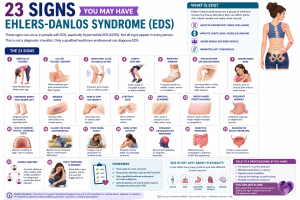
The following 23 signs can help you recognize patterns that may be worth discussing with a healthcare professional. They are not a diagnostic checklist, and many can occur in people who do not have EDS.
1. You were unusually flexible
Being able to bend farther than other children is one of the most recognizable features associated with EDS and other hypermobility conditions.
You may have been able to:
- bend your fingers backward unusually far
- put your palms flat on the floor without bending your knees
- bend your elbows or knees beyond what seemed typical
- perform unusual stretches without much effort
- put your thumb toward your forearm
- sit in positions that other children found uncomfortable
Some children are naturally flexible and have no health problems. Joint hypermobility by itself does not mean that you have EDS.
For generalized joint hypermobility, clinicians may use the Beighton scoring system, which assesses movement at several joints. The pediatric framework recognizes that children can have hypermobility outside the joints measured by the Beighton score.
2. People called you “double-jointed”
“Double-jointed” is an informal term rather than a medical diagnosis.
If teachers, family members, coaches or friends repeatedly commented on how far your joints could move, this may have reflected generalized joint hypermobility.
But there is an important distinction:
Hypermobility is a physical finding. EDS is a connective-tissue disorder.
Some people have generalized joint hypermobility without pain or disability. Others develop symptoms and may meet criteria for a hypermobility spectrum disorder or, depending on their overall clinical picture, hEDS.
3. Your joints frequently “popped,” clicked or cracked
Joint clicking and popping are common in the general population and are not specific to EDS.
However, if you experienced frequent joint noises together with pain, instability, recurrent sprains, or a feeling that a joint was moving in an unusual way, it may be worth mentioning to a clinician.
The more important issue is not the sound itself but whether the joint is unstable or repeatedly injured.
4. Your joints seemed to give way
Did your knee suddenly buckle?
Did your ankle roll unexpectedly?
Did your shoulder feel as though it was slipping out of position?
Joint instability is more clinically significant than flexibility alone. In hEDS, recurrent joint instability and atraumatic dislocations or subluxations can occur because connective tissues that help stabilize joints are affected.
5. You repeatedly sprained the same joints
Some children seem to be perpetually dealing with:
- ankle sprains
- knee injuries
- wrist injuries
- shoulder problems
- pulled muscles
- unexplained soft-tissue injuries
Repeated injuries can have many explanations, including sports, coordination problems and biomechanics. But recurrent sprains in the setting of generalized hypermobility may be clinically relevant.
6. You could partially or completely dislocate a joint
A joint dislocation occurs when the bones forming a joint are forced out of their normal position. A subluxation is a partial displacement.
Some people with EDS experience recurrent dislocations or instability with relatively little trauma. The 2017 hEDS criteria specifically include recurrent atraumatic dislocations or medically confirmed joint instability among the relevant musculoskeletal features.
A history of repeated dislocations is therefore much more significant than simply being flexible.
7. You had unexplained joint or muscle pain
Perhaps you had aches that never seemed to have a clear explanation.
You may have complained about:
- knee pain
- ankle pain
- hip pain
- shoulder pain
- back pain
- muscle aches
- pain after ordinary physical activity
In hEDS, chronic musculoskeletal pain is common. The formal adult diagnostic criteria include musculoskeletal pain in two or more limbs lasting at least three months, chronic widespread pain, or recurrent joint dislocations/instability as possible musculoskeletal manifestations.
Importantly, childhood pain has many possible causes and does not by itself indicate EDS.
8. You were constantly getting “growing pains” that never quite went away
Some children are told that recurring leg or body pain is simply growing pains.
Typical growing pains are generally benign. But persistent or recurrent musculoskeletal pain—particularly when accompanied by generalized hypermobility, instability or other connective-tissue features—may deserve a more detailed evaluation.
The important clue is the overall pattern, rather than the label you were given as a child.
9. You bruised very easily
Did you frequently have bruises without remembering how you got them?
Easy bruising is reported in several EDS subtypes and is part of the broader connective-tissue phenotype. In hEDS, easy bruising can occur alongside soft or hyperextensible skin and other connective-tissue features.
However, easy bruising is extremely nonspecific. Medications, nutritional deficiencies, platelet disorders and other medical conditions can also cause increased bruising.
Unexplained or excessive bruising should therefore be medically assessed rather than automatically attributed to EDS.
10. Your skin seemed unusually soft or velvety
Some people with hEDS have unusually soft or velvety skin.
This is one of the systemic connective-tissue features considered in the 2017 hEDS criteria.
Soft skin alone, however, is not enough to suggest EDS. Skin texture varies naturally among individuals.
11. Your skin seemed unusually stretchy
You may have noticed that your skin could be pulled farther than other people’s.
Mild skin hyperextensibility is one of the features considered in hEDS. More pronounced skin hyperextensibility and significant skin fragility can point toward other EDS subtypes and therefore require careful clinical assessment.
This distinction matters because not all EDS looks the same.
12. Your cuts or wounds healed with unusual scars
Scarring patterns can provide useful clues in some forms of EDS.
Classical EDS, for example, is associated with characteristic atrophic scars, while other EDS subtypes have different patterns of skin fragility or scarring.
If you have unusual, widened or thin scars—especially when combined with joint hypermobility and unusually stretchy or fragile skin—it is worth mentioning the history to a clinician.
13. You developed stretch marks without an obvious reason
Stretch marks, or striae, are common and can occur during puberty, pregnancy and periods of substantial changes in body size.
However, unexplained striae in certain locations and without a history of significant weight or body-fat changes are included among the systemic features considered in hEDS.
This is therefore a clue rather than proof of EDS.
14. You had frequent hernias
A hernia occurs when tissue pushes through a weakened area of the surrounding muscle or connective tissue.
Recurrent or multiple abdominal hernias, including umbilical or inguinal hernias, are among the systemic features considered in the hEDS diagnostic criteria.
A childhood hernia is not unusual on its own, so the significance depends on the broader clinical picture.
15. You had a high or narrow palate or crowded teeth
Dental crowding and a high or narrow palate are among the systemic features included in the 2017 hEDS criteria.
This is another example of why EDS cannot be identified from flexibility alone. Clinicians look for a pattern involving multiple body systems.
16. You were unusually clumsy or had poor coordination
Some children with joint hypermobility experience problems with coordination, balance or motor control.
The NHS notes that symptomatic joint hypermobility can be associated with poor balance or coordination, along with recurrent sprains, joint or muscle pain and fatigue.
Children with EDS or hypermobility may also develop motor delays or low muscle tone, although these findings are not specific to EDS. MedlinePlus notes that hypotonia and delayed motor milestones can occur in children with hypermobile EDS and other forms of EDS.
17. You tired more easily than other children
Perhaps physical activities that seemed easy for other children left you unusually exhausted.
Fatigue is reported in people with hEDS and hypermobility-related disorders. GeneReviews describes chronic fatigue among manifestations commonly reported in hEDS.
However, fatigue is one of the least specific symptoms on this list. Sleep disorders, anemia, thyroid disease, nutritional deficiencies, infections, mood disorders and many other conditions can cause fatigue.
It becomes more interesting when fatigue occurs alongside a longstanding pattern of hypermobility, pain and other connective-tissue features.
18. Physical activity often left you unusually sore
You may have noticed that exercise, sports or even ordinary physical activity seemed to cause disproportionate soreness.
Repeated soft-tissue injuries and chronic musculoskeletal pain can occur in hEDS, partly because unstable joints can place additional stress on muscles and surrounding tissues.
That does not mean that ordinary post-exercise soreness indicates EDS. The question is whether the pattern has been persistent, disproportionate or associated with recurrent injuries.
19. You had frequent headaches or migraines
Migraine is reported among the associated manifestations of hEDS.
But migraine is extremely common in the general population and has many causes.
A history of migraine therefore should not be interpreted as evidence of EDS by itself. It becomes potentially relevant when it occurs as part of a larger pattern of hypermobility and multisystem symptoms.
20. You had recurring digestive problems
Some people with hEDS report gastrointestinal symptoms, including functional gastrointestinal disorders.
GeneReviews lists functional bowel disorders among the clinical manifestations commonly reported in hEDS.
Depending on the person, gastrointestinal complaints may include symptoms such as abdominal discomfort, altered bowel habits, constipation or diarrhea.
Again, these symptoms are common and nonspecific. Irritable bowel syndrome, inflammatory bowel disease, celiac disease, food intolerances and many other conditions can cause similar symptoms.
21. You had bladder or pelvic problems
Bladder and pelvic symptoms can occur in people with hypermobility-related disorders.
The NHS lists bladder or bowel problems among possible symptoms of joint hypermobility syndrome, while pelvic floor and pelvic organ problems are among the manifestations considered in hEDS.
These symptoms should be evaluated on their own merits rather than automatically attributed to EDS.
22. Other people in your family had similar joint problems
EDS can run in families.
A family history can therefore be an important part of the clinical assessment. For hEDS specifically, the 2017 diagnostic criteria include a first-degree relative who independently meets the current hEDS criteria as one possible feature.
You may remember a parent, sibling or close relative who:
- was unusually flexible
- repeatedly dislocated joints
- had chronic unexplained pain
- bruised easily
- had unusually stretchy skin
- had similar musculoskeletal problems
A family pattern does not prove EDS, but it can provide an important clue.
23. You spent much of childhood being told that “nothing was wrong”
This may be the most frustrating sign of all.
You may have seen several doctors for different problems:
- recurring injuries
- joint pain
- fatigue
- digestive symptoms
- headaches
- bruising
- dizziness
- unexplained aches
Yet each problem was considered separately.
One reason connective-tissue disorders can be difficult to recognize is that their manifestations may involve multiple body systems and vary substantially from one person to another. EDS is also a group of different disorders rather than a single uniform disease.
A person may therefore spend years treating individual symptoms without anyone recognizing a broader pattern.
That said, having many unexplained symptoms does not automatically mean that EDS was the underlying cause.
So, do these 23 signs mean you have Ehlers-Danlos syndrome?
No.
This distinction is extremely important.
Many of the features discussed above—joint flexibility, bruising, fatigue, headaches, digestive symptoms, muscle pain and even recurrent injuries—are common in people who do not have EDS.
The diagnosis depends on the combination of findings, the person’s medical and family history, physical examination, and—in some EDS subtypes—genetic testing.
For hypermobile EDS, there is currently no single laboratory or genetic test that confirms the diagnosis. The diagnosis is clinical and requires fulfillment of specific criteria while excluding other conditions that can cause similar findings.
What if you had these symptoms as a child but were never diagnosed?
It is still possible to discuss them with a healthcare professional as an adult.
In fact, childhood history can be useful because joint hypermobility and connective-tissue manifestations can change over time.
The current diagnostic approach recognizes an important limitation: the 2017 hEDS criteria were developed primarily with adults in mind. Many features may not yet be present during childhood, and many findings are common among otherwise healthy children. A separate pediatric diagnostic framework was therefore developed for people from approximately age 5 through biological maturity.
This means that not meeting hEDS criteria as a child does not necessarily mean that your childhood symptoms were unrelated to a later diagnosis.
What should you do if you suspect EDS?
Start by documenting the pattern rather than trying to diagnose yourself from a symptom list.
Consider writing down:
- Which joints were unusually flexible?
- Did you have recurrent sprains or dislocations?
- When did chronic pain begin?
- Did you bruise unusually easily?
- Did you have unusual scars or stretch marks?
- Did you have hernias?
- Were there gastrointestinal, bladder or other recurring problems?
- Did close relatives have similar symptoms?
- Have you had previous diagnoses that never fully explained your symptoms?
Bring this history to a healthcare professional who is familiar with joint hypermobility and connective-tissue disorders.
Depending on your symptoms, evaluation may involve a physical examination, assessment of generalized joint hypermobility, review of skin and connective-tissue features, family history, and testing to rule out alternative diagnoses.
EDS is not the only explanation for hypermobility
This is another point that deserves emphasis.
Some people have generalized joint hypermobility but do not have EDS.
Others have symptoms related to hypermobility but do not meet the criteria for hEDS. These people may be diagnosed with a hypermobility spectrum disorder (HSD) after other causes have been considered.
The Ehlers-Danlos Society and GeneReviews both emphasize the distinction between joint hypermobility, HSD and hEDS. Joint hypermobility is a physical finding; it is not itself a diagnosis.
A final word about the phrase “you grew up with EDS”
If you recognize yourself in several items on this list, it is understandable to look back and wonder whether you “grew up with EDS.”
But a retrospective symptom list cannot establish that diagnosis.
A more accurate way to think about it is:
“Did I have a pattern of childhood features that could be consistent with EDS or another hypermobility-related condition?”
That is a question worth discussing with a qualified healthcare professional.
The goal is not to attach a label to every symptom you have ever experienced. It is to determine whether the symptoms form a medically meaningful pattern—and, if they do, to identify the most appropriate diagnosis and treatment.
Frequently Asked Questions
Can you have Ehlers-Danlos syndrome and not know it as a child?
Yes. Some manifestations may become more apparent over time, and the diagnostic criteria used for hEDS were developed primarily for adults. Children with generalized joint hypermobility are now assessed using a pediatric framework rather than simply applying the adult hEDS criteria.
Is being very flexible a sign of EDS?
It can be, but flexibility alone does not mean that someone has EDS. Many healthy children and adults are naturally hypermobile. Clinicians consider generalized hypermobility alongside musculoskeletal complications, skin and connective-tissue features, family history and other findings.
Can EDS cause pain in children?
Hypermobility-related pain and musculoskeletal problems can occur in children, although pain has many possible causes. Persistent or recurrent pain combined with generalized hypermobility should be discussed with a healthcare professional.
Can EDS cause easy bruising?
Easy bruising occurs in several EDS subtypes and can occur in hEDS. However, easy bruising has many other possible causes and should not be used by itself to diagnose EDS.
Is there a genetic test for Ehlers-Danlos syndrome?
It depends on the EDS subtype. Many EDS subtypes have known genetic causes and can be confirmed with molecular genetic testing. Hypermobile EDS is different: there is currently no identified genetic marker or laboratory test that confirms hEDS, so diagnosis is based on clinical criteria and exclusion of alternative diagnoses.
What is the difference between EDS and hypermobility spectrum disorder?
EDS refers to a group of defined connective-tissue disorders. Hypermobility spectrum disorders describe symptomatic joint hypermobility that does not meet the criteria for hEDS or another specific connective-tissue disorder.
When should you see a doctor?
Consider seeking medical evaluation if you have persistent or recurrent joint pain, repeated dislocations or sprains, significant joint instability, unusual skin findings, unexplained easy bruising, or several symptoms occurring together.
Seek urgent medical attention for severe or sudden symptoms such as major trauma, a suspected dislocation, severe unexplained bleeding, sudden severe chest or abdominal pain, fainting with concerning symptoms, or other symptoms that could represent an emergency.
References and Resources
1. GeneReviews: Hypermobile Ehlers-Danlos Syndrome.
A detailed, clinically oriented reference covering the clinical features, diagnostic criteria, differential diagnosis, management and genetics of hEDS.
NCBI GeneReviews — Hypermobile Ehlers-Danlos Syndrome
2. The Ehlers-Danlos Society: Diagnostic Criteria.
Provides the current clinical criteria for hEDS and explains the distinction between hEDS and other hypermobility-related conditions.
Ehlers-Danlos Society — Diagnostic Criteria
3. The Ehlers-Danlos Society: 2023 Diagnostic Framework for Pediatric Joint Hypermobility.
Important resource for understanding why children and adolescents should not simply be assessed using the adult 2017 hEDS criteria.
Ehlers-Danlos Society — Pediatric Joint Hypermobility Diagnostic Framework
4. Malfait F, et al. The 2017 international classification of the Ehlers-Danlos syndromes.
The international classification describing the 13 recognized EDS subtypes and their clinical criteria.
PubMed — The 2017 international classification of the Ehlers-Danlos syndromes
5. MedlinePlus Genetics: Ehlers-Danlos syndrome.
A U.S. National Library of Medicine resource covering the genetics, major clinical features and different types of EDS.
MedlinePlus Genetics — Ehlers-Danlos Syndrome
6. NHS: Ehlers-Danlos syndromes.
A patient-oriented overview of EDS and hypermobility spectrum disorder, including when to seek medical advice.
NHS — Ehlers-Danlos Syndromes
7. Ehlers-Danlos Society: EDS Diagnostics 2017.
Provides additional explanation of the clinical assessment process, including joint hypermobility assessment, physical examination and family history.
Ehlers-Danlos Society — EDS Diagnostics 2017
Medical disclaimer
This article is intended for general educational purposes and is not a substitute for an examination, diagnosis or individualized medical advice. The presence of one or more signs described here does not establish Ehlers-Danlos syndrome. EDS comprises multiple subtypes with different clinical features, and many of the symptoms discussed can occur in other conditions or in people without EDS. A qualified healthcare professional should evaluate persistent, recurrent or concerning symptoms.
Related Reads



Latest Posts





ADVERTISEMENT